
We Smoked the Last One and Hours Ago #3 -- Joni Mitchell, David Lang, & Harold Meltzer
We Smoked the Last One and Hours Ago #3 -- Joni Mitchell, David Lang, & Harold Meltzer
I’m jotting down thoghts for my next talk at the Berlin Academy of American Music’s Composers Workshop, June 29 to July 5.
Without thinking, often even without overthinking, US music stays with what works.
Those working in an uptown head could be more likely to be guilty of overreach; I see it sometimes going down the rabbitt hole of the not even wrong. But I admire ambitious uptown composers. Sometimes they succeed in remarkable and surprising musical feats.
Minimilism was too minimal for some. I agree with what I heard from Marty Goldray and Rodney Sharman, echoing others, who insisted that minimalism was a modernism.
I argue for that and I argue there is no need for a schism.
Uptown composers could be absolutist, as Wuorinen was to the very end. “I thought we were going to write music with twelve notes,” he said to me once. That stricture, that entry fee, was to follow the bridge burning of Schoneberg and later Boulez/Leibowitz.
I try today to chew off one exciting principle that unifies uptown and downtown.
Here’s Ethel/Kyle Miller’s adaptation of David Lang’s “Wed”. Kyle created a piano sound for his e-guitar.
https://www.youtube.com/watch?v=eFWCvs7KQ40&list=RDeFWCvs7KQ40&start_radio=1
We take away from this lovely movement a sound (a collection) The Princetonians would say the sound that we take away from this is 034, for exampel, [A, C, C#]. It’s transparent. We hear it. We hear 034 floating in pan-diatonic water. Mozart loved the sharp 9 move. In Mozart’s case, it stands out, floating in *functional harmonic water*.
Sor does what I call the #9 move here:
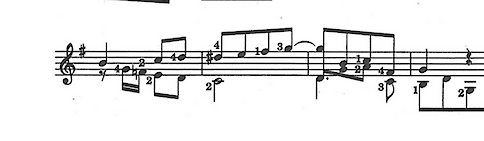
If that 6/4 chord no longer does it for you, the #9 move grabs you and makes sure you don’t miss the conclusion of the phrase.
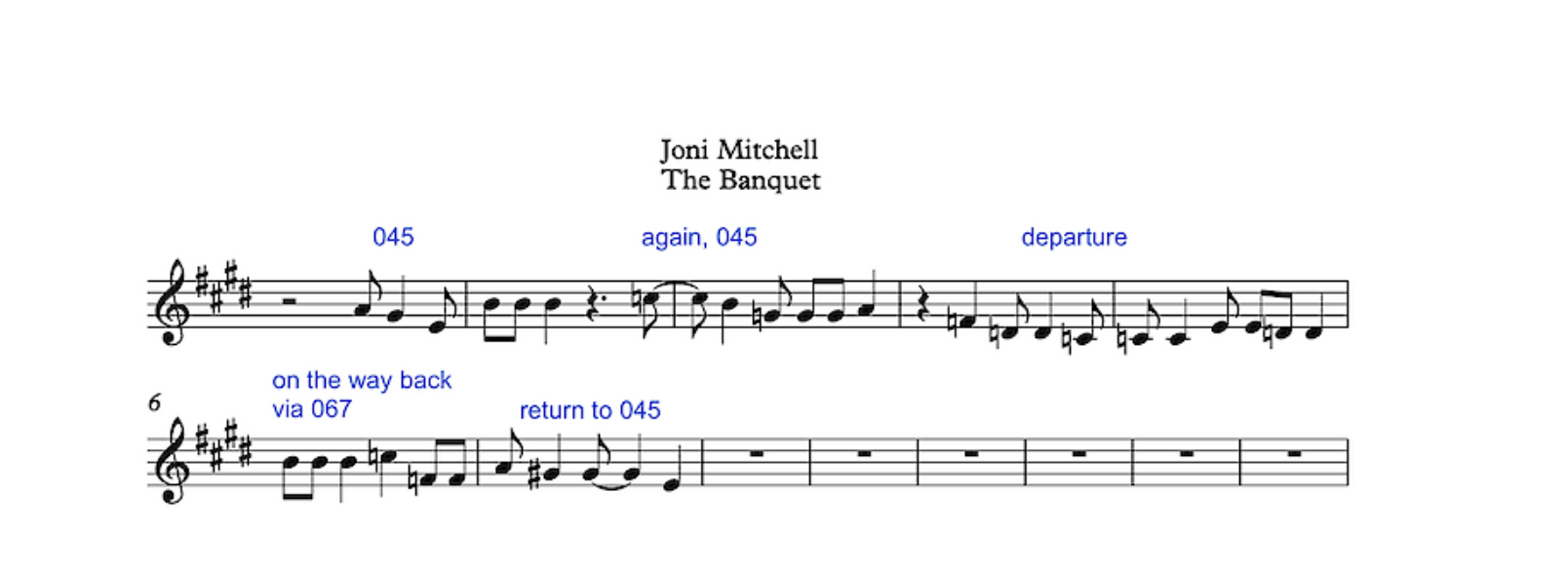
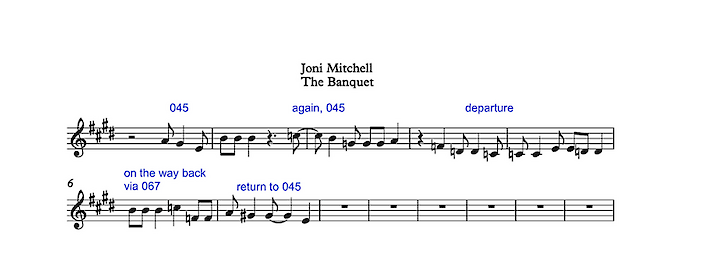
Here, Joni Mitchell holds 045 –
Brahms *holds* 045 throughout his op. 88. In the opening bar we here it horizontally and vertically –
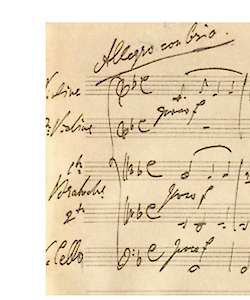
He transposes it by major thirds – his background bass line is an augmented scale. Transpose the major 7th chord by major thirds and you get an augmented scale. Schoenberg had great fun with the augmented scale. The Princetonians call the augmented scale *the E Hexachord*.
More about this *holding* things in some kind of water HERE – scroll to “Holding”.
In David Lang’s *Little Match Girl*, each movement *holds* a distinct collection – a quality, a chord quality.
Harold Meltzer told me he’s uptown. He had a good reason to think that I cared. Yes, I love some uptown composers, I fell in with them, and for a long time I did consider them the ambitious and serious ones. But there are so many ways to be serious and so much to be serious about outside the value structures that we fell into.
His hit song, “Brion” is about Carlo Scarpa’s Brion Vega Cemetary. The opening sketches the countryside. We hear that three times; the last is crepuscular. Each little musical section is mausoleum. And each section is also bridges to the next in a way that Meltzer was very proud of. He spoke of a big chord and each section is a subset. Like Brahms’ background augmented scale, Meltzer’s Brion has a spine.
And perhaps Lang’s “Little Match Girl” is organized in some similar fashion. I haven’t looked under the hood.
I fell in with some uptown composers who think of their 0 harmony as something much like the tonic triad, and some liked to speak of prolonging it for a middle ground spell. I think of Joni Mitchell’s “The Banquet” as a pristine example. One difference that I noticed was that some want to preserve the chord quality thoughout the phrase. I call that Webernian, who kept one chord quality (a trichord, transposed, inverted, etc.) throughout an entire movement. I like they way Joni Mitchell *breaks* her 0 harmony. Doesn’t that enhance its return?
21st C. cares about unity, but we’re not OCD about it.
In Schoenbert’s op. 9 every interval cycle is represented as a theme. I like that disregard for unity. Schoenberg’s 12-tone works are too unified, but that doesn’t bother me becasue they’re so well done. It bothers me becasue too many bad attempts at being too unified followed S/chenberg and Boulez like a flock of sheep. Too many were not disposed that way. I wasn’t. We can admire the strong examples without trying to do what’s not in us.
I hope this is clear. I like *holding* and I like *breaking what we’d been holding* at the right time, with just the right malice aforethought. This requires just a bit of discipline, and I admire the discipline evident in the Lang & Meltzer examples.
Disciplines form around traditions. Traditions require priesthoods, shamans, and such. While there is a lot of *anything goes in the US*, there are some lovely examples of music that finds its way to the unfathomable, unmeasurable collective wisdom of the musical ages.






William Anderson is a guitarist and composer and an advisor to the Roger Shapiro Fund.