
Emil Awad on Schoenberg/Babbitt Hexachordal poetics
Emil Awad on Schoenberg/Babbitt Hexachordal poetics
Mario Davidovsky was an honored guest at FICA21, a new music festival and seminar at the Universiad Veracruzana. He later convinced FICA212’s founder and Director Emil Awad to bring me to Xalapa 15 or 20 years ago.
Emil Awad finished high school in the Juilliard preparatory program. He went on to study with Babbitt, Martino, and many others at Juilliard, Manhattan School and Harvard.
I’ve attended FICA21 very regularly since then, a great admirer of the music that Awad has cultivated there. Over the years he welcomed me as a partner and we worked together building a musical tradition that bridges New York and Xalapa, with excursions to Europe.
He & I invited many colleagues to Xalapa. Jay Eckhardt, Jonathan Dawe, Frank Brickle, Suzanne Farrin, Jeff Nichols, David Schober were all guest composers for Emil’s FICA21 – Festival Internacional Camarata 21, which began 23 years ago.
Emil & I brought UV composers to New York, Austria, and France. I brought Queens College and Sarah Lawrence guitarists to Xalapa.
The idea was to learn from one another. I gained clarity last week about a subject dear to Emil.
We talked endlessly about musical matters in cafes, making notes on napkins and scratch paper. And if I felt that one of his points was still too much of a vague abstraction, I’d keep asking him about it, year after year.
Emil is passionate about an analagy to Schenker –
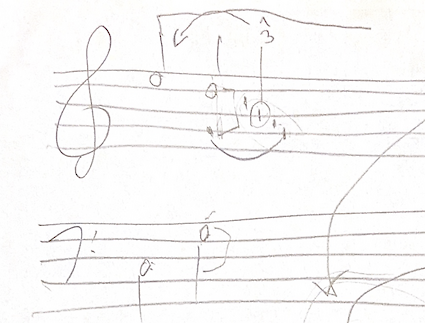
This week something clicked. I’d been tripping over terms. His talk of the trichord “lifting out of the 0 region into another area”. I would remind him that he still has not quite made it clear ot me. It was helpful to have Angel Mendez and Jonathan Dawe around because they woud clarify some terms like “area”. Princetonese must be mastered, and people do resist.
Awad is not dogmatic about compositional practice. I think we both agree broadly that we must not sound like 20th C. composers. I honor 20th C. principles by trying to make them sound like something else, like a budding green 21st C. thing. Quiddies are deepr, more powerful, if they are not wedded to a style. Baroque quiddies persisted after Baroque mannerisms were abandoned.
Emil & I agree that 20th C. meannerisms – uncomprehending imitations of modernist surfaces – ended modernism and rendered it vulnerable to the Rockwell Coup.
I came up with a term and used it on Frank Brickle–*whatitisity*. He liked it becasue he felt it was a good enough translation of the Latin, “quidditas”.
I will now honor Emil by trying to employ this without sounding 20th C.
Here are our notes from our conversation last week at the Cafe Florcatorce, near the conservatory. Doctoral student Angel Mendez was there to help out as well –
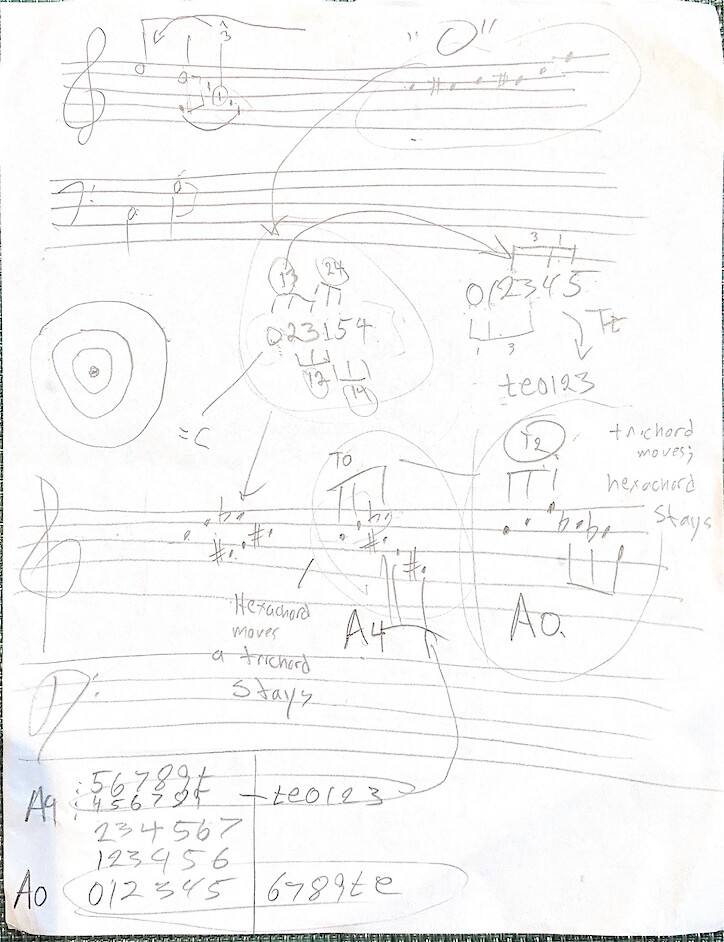
This is a very particular way of moving around in the middle ground. It prolongs a hexachord in a beautiful way.
This is not sudoku.
The accusation is a stumbling block. The barbarians at the gate cry, “this is sudoku; this is math, not music.”
The Schenkerian analogies are crucial. If you hate Schenker, then I’d discard that and say, this is about phrases, what they do and how they can work. We instate something, we float through a mid-phase, we land at phrase end. Find your own words.
The *0* region is like the tonic triad. We instate it, transpose it through the mid-phrase and perhaps return to it, land back on it, perhaps re-disposed, at phrase end.
Emil, this modality that you describe preserves a quality, as in a *chord quality* through a phrase. (Quality = interval content). This is precisely how Brickle presented it, but more seat-of-the-pants. I have a personal need or predilection to break the quality midphrase, and return at phrase end. This can point to a large scale break–a background move.
When Jeff Nichols says he is allergic to Webernian rows he means something very similar, I suspect. I share that with him. Another thing I share with Jeff Nichols is that I like my *0* to be a tetrachord. Jeff told me he’s a tetrachord guy. A hexachord is too big. The reconciliation is found in Babbitt’s landing on trichordal signatures of the hexachord.
Now I hope to see some of this in the wild. Is something like this at work in Emil Awad’s “Fouad”? I should study some scores of Angel Mendez and Estrella Cabildo.
“Fouad” is Awad’s first foray into adapting flamenco guitar techniques. He now has a set of 5 etudes that do further in that direction. Flamenco is his way to move away from the 20th C. modernist surface. Perhaps we can say it’s his post-modernism. And he comes to it honestly.
Babbitt called himself a Schoenbergian. What Emil describes here could be at the heart of what makes Babbitt a Schoenbergian.
Is this kind of thing at work in Babbitt’s Swan Song No. 1? Emil insists that this modality can be found in array pieces, but he warns that arrays both complicate the proceedings profoundly, while also, surprisingly, bring the issues right to the surface.
And perhaps only Babbitt and David Lewin really understand the deeper ramifications. Brickle may have understood, but he never tried to go down that rabbit hole with me.
When I was messing around with arrays and superarrays and multiply partitioned arrays (early 00s), Brickle said only one thing: focus on the inversional pairs. What he meant was, the deep Lewin and Babbitt quiddies are in those. The Babbitt article about invesional pairs and Dallapicola may be key.
Another point that I established with Brickle is that superarrays are more than counterpoints of arrays. But he never took me down that rabbit hole either. He did say that Babbitt’s superarray maker (What was his name? He also engraved Babbitt’s music in Score.) helped generate the superarrays through a process that churns out pitches. This was not farming out the work of compositon.
I consider this an admirable leap into the 21st C.
My notes here are very old and flaunt my ignorance –
The 0 hexachord here is this diatonic hexachord
E F# G# A B C#
The circled triplet returns throughout the work, usually holding 015.
I need Emil to connect the doings here with the modality that he describes.
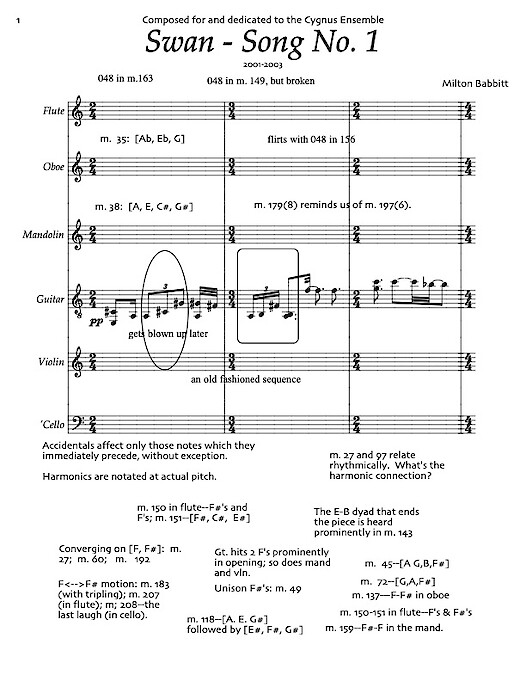
When the mandolin enters, the trichord lifts us out of the 0 hexachord into T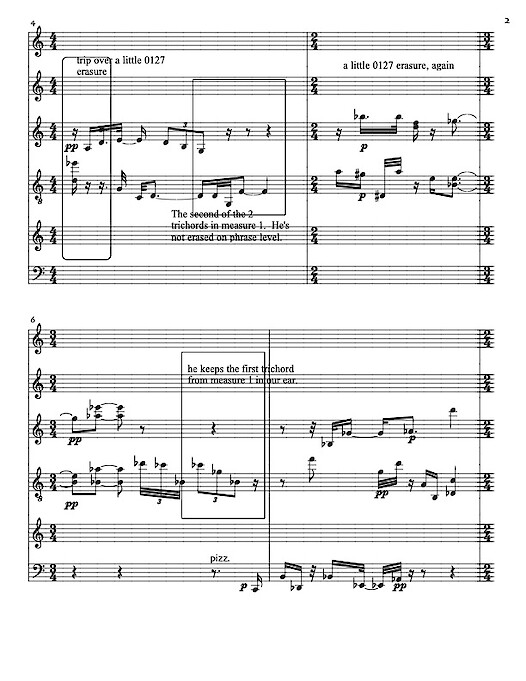




William Anderson is a guitarist and composer and an advisor to the Roger Shapiro Fund.