
Fallout from The Death of Tragedy
Fallout from The Death of Tragedy
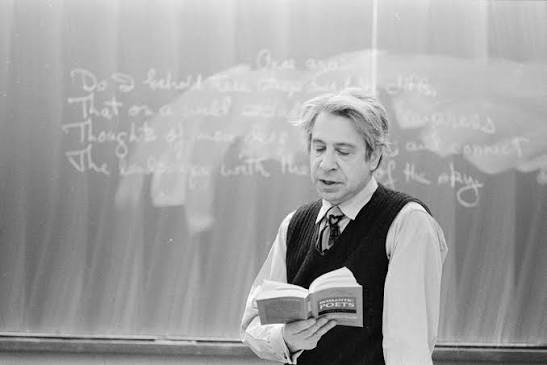
depicted: Ted Hughes. Harold Meltzer set him. Check out his Shakespeare book.
Fallout from the Death of Tragedy
–Armida, and what the tragic economy required–
TLDR: First corollary to the death of tragedy is that essentializing is not necessary, post-tragedy. The mechanism that required it fell away, post-tragedy.
The Armida story — Tasso’s sorceress, sent to sabotage the Crusader camp, who falls in love with the knight Rinaldo and holds him captive in an enchanted garden until his comrades hold a diamond shield to his face and show him what he has become — was set by Lully, Handel, Gluck, Haydn, and Rossini, among many others, across more than two centuries. It is worth asking why one story served opera’s reason-versus-passion economy so durably, and Schiller’s own vocabulary answers the question almost too exactly.
The diamond shield is his mechanism in miniature. Rinaldo does not break the enchantment through will pitted directly against Armida. He needs an image communicated to him from outside himself — a mirror, showing him dressed in soft finery while his comrades die at the walls — before resistance becomes available to him at all. This is the same operation as Schiller’s Laocoön passage: fear with “an objective basis in the object,” an image received rather than merely felt, against which the mind can finally measure its own freedom. Without the shield, there is no gap for the will to cross. The shield manufactures the confrontation Schiller’s aesthetic requires before dignity can be earned.
And Armida herself is that aesthetic’s onslaught given a face. She must be genuinely overwhelming — beauty and magic at full strength, nothing held back — for Rinaldo’s escape to register as sublime rather than as a convenience. Schiller’s own demand, that nature “demonstrate all its might before our eyes” before intelligence can prove itself against it, requires exactly the Armida the tradition kept building: not a lesser temptation, but a power capable of erasing a man’s memory of his own name.
Here the pathology sharpens. If dignity is earned only by resisting an overwhelming sensuous force, and the force keeps being cast as a woman — Armida, Circe, Kundry, Venus in the Venusberg — the tragic economy does not merely feature seductive women. It requires one, structurally, the way Schiller’s sublime requires a storm. The genre needs something to be nature so that the hero has something to prove his reason against. This is not a claim about which composers held which opinions of women. It is a claim about what the machinery of earned dignity needs supplied, regardless of anyone’s intentions, in order to run at all.
Which gives the essay’s corollary a mechanism rather than a mood. Remove the requirement that dignity be earned through resistance to an overwhelming force, and the requirement that someone be cast as that force goes with it. Nobody has to be nature so that someone else can be freedom. Amor fati and the tending-without-conquest position hold no diamond shield up to anyone. Stifter’s doctor makes his rounds without a Circe to leave behind on an island. It is not that a later age grew kinder. It is that a specific economy, which needed a specific casting to operate, stopped being the only economy running.
Hughes, and a harder case
Ted Hughes’s Shakespeare and the Goddess of Complete Being (1992) argues that one myth runs beneath the whole canon: a self-sufficient young man — Adonis refusing Venus — is destroyed by a boar that turns out to be the goddess’s own rejected love, returned as fury. Hughes traces the equation across the tragedies: refusal of the female principle does not produce dignity. It summons the very destruction the refusal was meant to hold off.
This looks, at first, like a way out of Schiller’s economy, since it reverses the verdict — resistance is now the crime, not the achievement. It is not a way out. It is the same apparatus with the correct answer changed. Hughes keeps woman cast as the embodiment of sensual nature, keeps a man’s stance toward her as the thing that determines his fate, and simply insists the stance must be acceptance rather than resistance. Perhaps the boar is still Schiller’s storm. Only the required response to it has flipped. Hughes has not unseated the requirement that someone be cast as the force a man must reckon with. He has written that economy’s guilty conscience from inside it.
The position this essay has been tracing — Stifter’s, and what can be heard in Brahms — agrees with Hughes at exactly one point and no further: the goddess should not be refused. Everything else divides. Hughes stays inside the confrontation and changes which answer is correct. Stifter’s tending declines the confrontation at its first premise, not its second. Woman is never nominated as the embodiment of the sensual in the first place, so there is no boar to fear and no goddess to appease, because the apparatus that produces a boar or a goddess out of a woman has been declined before it starts.
What licenses declining it there, rather than merely answering it differently, is closer to William James than to Hughes: reason was never untethered from the body, never a separate faculty summoned only in confrontation with what it is not. Schiller’s machine, and Hughes’s inversion of it, both require reason and sensual nature to be two things that can be pitted against each other, one carried by a man’s will and one displaced onto a woman for him to face. If they were never actually apart — if reason is continuous with a body’s own constellation of relations rather than elsewhere, and only elsewhere when confronted — there is nothing to stage between them. Not reason mastering nature, and not will reconciled with the goddess it once refused. No boar, because nothing was ever refused to bring one.
The second corollary: the hero’s role, vacated
The first corollary concerns who had to be cast as nature. The second concerns who got to occupy the other chair, and the same mechanism runs through it from the opposite side.
Schiller’s hero is not admired for having power. He is admired for a comparison that has to be staged and held: an overwhelming force met, and a will that proves itself larger. The role only means something because the economy pricing it is real — because dignity earned this way was, within that economy, an actual achievement, checked against a genuine confrontation, not merely claimed. Take the economy away and the role does not become nobler for want of a wearer. It becomes available to anyone prepared to strike the posture, since nothing underwrites the posture any longer except the performance of it.
This is why strength of will and appetite for domination now so often turn up in people who are not, by any other measure, impressive. The costume has not changed. Magnitude of will over its direction, contempt for the mediocre, admiration tracking power rather than what the power serves — this is Schiller’s own page sixty-eight (in the German Library #17), read straight. What has changed is that the comparison the costume once required has no one left checking it. A strongman today is not Rinaldo returned to the war. He is a man wearing armor from an economy that has stopped issuing it, in a theater where no one is holding up the shield.
The Misfits, and the vacated role made literal
Arthur Miller staged this collapse directly, in the story and the screenplay he called The Misfits. Gay Langland and his companions chase wild mustangs across the Nevada flats, and they still speak the old vocabulary in full — freedom, the untamed range, mastery over something wild enough to be worth mastering. What they are actually doing is running down a small, worn-out band of horses to be sold for dog food. The costume is intact. The economy that made wearing it heroic is gone, and the title names both halves of the collapse at once: the horses, no longer useful enough to be worth anything but slaughter, and the men chasing them, no longer fitted to a country that has moved on from what they are.
Roslyn is the shield nobody in Rinaldo’s story thought to hold up from outside the myth. She is horrified by the roping not because she misreads what is happening but because she sees exactly what it is — old men staging conquest over a broken animal, in the vocabulary of a freedom that belongs to neither of them any longer. What she shows the men is not a hero shamed back into glory. It is a costume with nothing left inside it.
Goethe was frustrated. Lenz should not have gone insane. He should have read and heeded *Werther*.
We are frustrated. With raised fists we are imploring: “This was all covered by Arthur Miller sixty years ago!”





William Anderson is a guitarist and composer and an advisor to the Roger Shapiro Fund.