
Kyle Miller's "Ven"
Kyle Miller's "Ven"
The album *Bed of Creeks and Coils* is now released on New Focus Records.
Kyle Miller one of the rare composers who takes on the formidable task of negotiating the powerful redolences of the famililar. I take that as a noble challenge. He shares this penchant with Scott Johnson.
Miller is from Long Island, one of the birthplaces of Death Metal. I understand that Long Island rivals Tampa for the distinction.
The center of it is Cannibal Corpse’s predecessor scene, but the real institutional hub was Vinnie Cianni’s studio and the “Long Island scene” clustered around a handful of bands in the mid-to-late 1980s. The two towering names:
Suffocation, formed 1988 in Centereach/Medford, Long Island — widely credited as pioneers of a specific subgenre, brutal/technical death metal, built on the alternating slam-and-blast-beat structure (“breakdown” riffing married to extreme tremolo picking) that became a template copied worldwide. Their early demos and Effigy of the Forgotten (1991) are foundational texts of the genre.
Immolation, formed 1986 in Yonkers/later based on Long Island — dissonant, atmospheric, technically intricate death metal with a darker, more anti-religious thematic bent, also hugely influential.
Beyond those two: Mortician (Long Island, notoriously slow/heavy “gorno” style), and the broader network of bands, labels (Relapse and others had early Long Island ties), and all-ages venues and record shops that let teenagers trade demo tapes in the pre-internet era — Long Island’s suburban geography, oddly, produced exactly the kind of bored, car-dependent teenage subculture that death metal’s other hubs (Tampa, Stockholm) also drew on.
Why Long Island specifically: scholars and fans of the genre’s history point to a few factors — proximity to but alienation from Manhattan’s media/music industry, a dense suburban network of practice-space garages and small clubs, and specific record stores/labels that functioned as scene hubs, letting a fairly small number of interconnected musicians cross-pollinate bands rapidly (several of Suffocation’s and Immolation’s members moved between lineups).
And there’s a band called “Death” with a website called, “Empty Words”.
The point about Death Metal’s alienation from Manhattan’s media/music industry is something that I like about Queens College, where Miller & I met. It’s more immune from fashion, although Long Island Death Metal may have its own fashions.
I heard some of Miller’s earliest works in which heavy metal redolences overwhelemed me, but at the same time, Miller’s wit and intelligence were already beginning to overpower the redolences of a vernacular music. “Ven”, a set of three electric guitar quartets goes much further in this process of overwhelming native roots.
The microtonal gliss at the end of “Ven: II. Flux” kills me. Do we not find that those overused words, “kills me” is somehow a known and understood element in Death Metal? And there is psychology and poetic tradition that I feel bears on “kills me”. We get to that.
I’m beginning to notice that there are lighter and heavier bits in “Ven”. And I begin to detect in the lighter bits a sense of humor, maybe references to things known in the garage that we don’t necessarily know.
Miller never told me he comes from Death Metal. There are many, many kinds of metal, with many amusing names. Miller is an engineer/producer, with a studio on Long Isalnd, and I imagine he works with every imaginable heavy metal strain. I suspect at this point he’s pan-metal.
And neverthess, “Ven” is dark. Does “Ven” feels like a memento mori, like Weiss’s Tombeau de Comte do Logy or Louis Couperin’s Tombeau do Blancrocher?
And do we detect a bit of the antiestablishment, and anti-specactacle energy, mentioned above?
Ven is *in the game*; it has a game going – pitch games, played with wit. And I’m learning to listen more carefully, which involves taking “wit” in Jean Paul’s sense: wit as the faculty of finding likeness between remote things. Jean Paul puts it this way: wit acts like a priest marrying couples nobody expected to see joined. The game is the courtship; wit is the priest?
Each move in the game is rendered as a specific, sensuous event — Jean Paul’s discipline of applied finitude — and the specific events are related to each other by unexpected likeness rather than by mechanical continuation. By “mechanical” we touch on habits of thinking that can be untethered from the *sensuous* (as used by Schiller as well as Jea Paul). Maybe refine the warning to: “don’t believe everything you think”. There are musical strategies that make sense to our brains without having any ability whatsoever to get their teeth into our flesh. Do they touch ground?
Let’s make plans to look into the work Yuri Lotman, who focuses on games and double consciousness. A pitch game in Jean Paul’s witty sense — the abstraction individuated into something exact, two remote things married by an unexpected likeness — is doing Lotman’s double-coding in miniature: you hear the specific gesture and you hear it as an instance of the abstract structural idea, both at once, neither canceling the other.
These are extensions and you can tell me if they don’t fly. Extending wit outside of the realm of humor is what I see in music and extends Jean Paul beyond his intentions and I am likewise carrying Turi Lotman’s arguments into territory that is remote to his discipline.
As Ven sets a dark tone, the game *contains*, or, better yet, *is seen in constant contention* with the bottomless rabbit hole of death and dying. That *being in the game* cuts in another direction than the memento mori blade. Death (dying, the issue of mortality) *may* have a container and can get one in the composition process. The object uncontained, I believe is, “I Am Sitting in a Room” and Cage’s “if you don’t like it, listen again; if you still don’t like it listen again…..”
“Bed of Creeks and Coils” is one of the most joyful works I’ve played. It’s performed by Bodies Electric, John Chang’s electric guitar choir, which sometimes includes me.
“Wavering Radiant” is more edgy, but there’s something keeping it from flying away (succumbing to centrifugal forces). It has bits that are perhaps no less scary than “Ven”, but “Wavering Radiant” has a frame, the chromatic trichord begins and ends, and it has clear transitions that pop.
Bravo the pair – Daniel Conant joins the composer in this performance.
“Ven” is more like free verse and so its elements are not so contained in a form. We may discover its form (that arrangement of lighter and darker material, perhaps) and prove me wrong, but I think it’s safe to say that “Wavering Radiant” is more like a formal garden. “Ven” is a rock garden.
Bed of Creeks and Coils is a straight ahead Passacaglia. It’s joyful in part becasue we do not get lost in it. We always or almost always know where we are.
Broch’s introduciton to the collected prose of Hugo von Hofmannsthal (Bollingen) helps here.
On page xxi, Broch says popular poetry “masters the lyrical shortening of symbol-chains in a natural way, in such mysterious simplicity that all the identification-mysticism of the aestheticists pales by comparison and disappears.”
“Ven”
There are forms that are coin of the realm – conventional, acquiring the currency of the allegorical – consistent with the conventions of lyrical poetry. Form keeps us from the potetially infinite allure (what Broch means by identification-mysticism) of free verse or pure sound. I’m not sure but I think my line on this matter is equivalent to Broch’s: *form discontents the contents* is my cute line.
Death metal – what Broch means and what I mean is in the designation, “death metal”. The musical thing can have great power over us. What I’m observing about Kyle’s “Ven” is that by being more free, less formal, it’s scarier.
“Wavering Radiant” gets its radiance by mastering its scary content. The content, in places, is just as scary, but the *discontenting* holds the scary at arm’s length.
The Broch discussion would not be unfamiliar to Aleister Crowley, who, like Yeats and Lorca, tapped into esoteric traditions to express much the same thing. Crowley, Yeats and Lorca, and add Gustav Meyrink, they all share a vocabulary. Crowley is the link between Symbolisme and Led Zepplin and such.
And I discovered that in “Ven” Miller holds onto a harmony for a middle-ground duration. This is one thing that distinguishes it from free-improv, one thing among many others, but for me it is as central as all the semantic mechanisms of Baroque and pop phrases and their underlying harmonic progressions.
Putting a pin here: how far does “not-free improv” go in defining a classical perspective? I talk incessantly about how tired I am of verse libre. Perhaps, “not musical free verse” goes a bit further than, “not free-iprov”? My discontent lies within a world where romanticism is a default position, mostly unexamined.
I won’t go up against *free play in the void*. That’s where it’s all happening now. But it’s not me. I’m with Jean Paul:
“It follows from the lawless caprice of the present spirit of the age — which would rather self-addictedly annihilate the world and the universe, merely to empty out for itself a free space for play in the nothingness, and which tears off the bandage of its wounds as if it were a fetter — that it must speak contemptuously of the imitation and study of nature.”
But to get my relation to Jean Paul’s description of poetic nihilsts, replace “study of nature” with “that which distinguishes classical from romantic”, or “that which distinguishes free verse from lyric. The *nature* of such is in the way such devices *get into our bodies* and *complement* our mental faculties, if not contending with them or usurping them.
I’ve been very impressed with Miller’s work and now, after looking under the hood a bit, I find he’s onto some structural elements that resonate with me. This makes his work useful to me. He adds pitches. Dina Koston’s Berio lesson in a few sentences was: “set pitches in registers, then you add pitches”. And I see in the passage below that he begins to hold a specific quality?
Useful in many ways including this: he joins a conversation that’s been ongoing. See my discussion of Scott John’s “Bowery Haunt”, a wickedly brilliant electric guitar duo that I commissioned for Cygnus. I write about it here – What Scott Knew. In Bowery Haunt Johnson holds and lets go. The holding and letting go of the major 7th chord quality is very brilliantly handled and it breaks out of the prevailing heavy metal sonorities.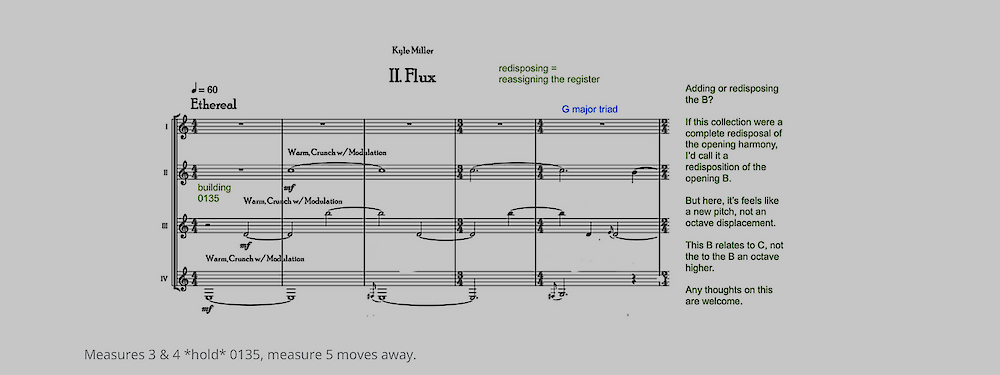
Measures 3 & 4 *hold* 0135, measure 5 moves away.
By holding onto a harmony, he lets it *get its teeth into you*. “Gets its teeth into you” is a Brickle expression that stuck. It is his translaion of Schiller and Jean Paul’s “sensuous experience”.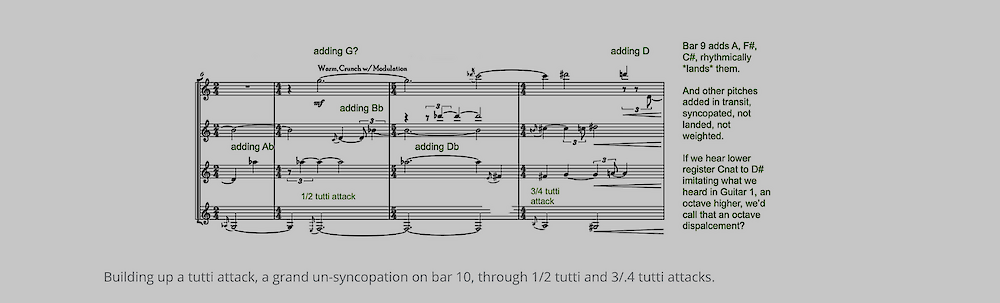
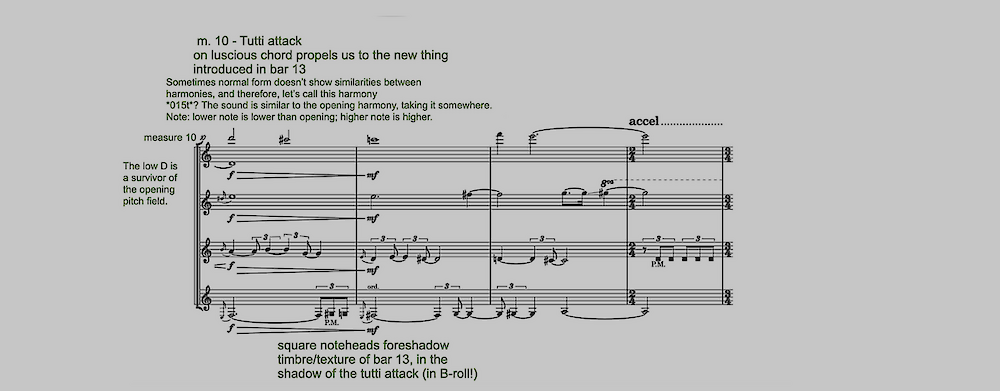
Miller builds up a tutti attack, a grand un-syncopation on bar 10, through 1/2 tutti and 3/.4 tutti attacks.






William Anderson is a guitarist and composer and an advisor to the Roger Shapiro Fund.