
Letter to A.M.
Letter to A.M.
Dear AM,
Like Fanny Doolie we like passing tones, but neighboring tones are merely for “shits and giggles”.
I keep learning from your value judgement. I go back to it again and again. I agree in principle with it, but I cannot think of a specific case of a neighboring tone that we see in the wild that would bring me to that objection. I’ll keep looking.
Passing tones are understandable. In root position progressions, they connect bass notes when the roots are a 3rd or 4th apart. That’s the example we discussed – walk-downs. There are many other kinds of passing tones.
Nieghboring tones, on the other hand, don’t do anything. They are mere ornaments.
I make judgements like yours. They are jumping off places and they are useful, even if they undermine themselves as the generality falls into a specific situation.
These are good puns:
An alligator wearing a vest is an investigator.
Why shouldn’t you trust stairs? They’re always up to something.
Broken pencils are pointless.
This is a better pun:
Time flies like and arrow; fruit flies like a bananna.
Here, “flies” flips from a verb to a noun; “like” flips from a simile to a transitive verb. In the fruit fly pun there is a greater density of pun stuff. May I rate puns based on density? There will be puns that I might rate as high as the fruit fly pun for other reasons that I can’t imagine at the moment. Puns are *supply-sided*?
Supply-sided: I never knew I wanted to hear 16th notes phase to 32nd notes until Steve Reich wrote his “Piano Phase”. But the game is still more charming for the fact that with each phasing, the collection of pitches gets a modal inflection. That’s counterpoint, a counterpoint of values, or the apple of phasing and the orange of the modal shift.
Generalities can help us and they can trip us up.
I am committed to music that puns through transpositon. That’s a fast road to hell. Or at least it’s a fast road to 12-equal divisions of the octave, but some microtonal people surprise me by pulling rabbits out of hats, coming up with some compelling music that doesn’t do any of the things the I feel music should do.
Puns are worthless. Music might be equally useless, unless it makes us happy, which is something. Let’s say music and puns are a big zero. We can express zero as
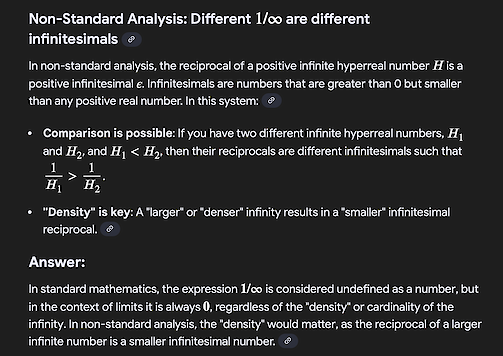
1/∞ = 0
The logical positivists gleefully reduce all metaphysics to formal tautologies. I think of a formal taughtology as a 0=0 or 1/∞ = 0, and we can keep finding ever more elegant expressions of zero.
There are infinities of diverse densities.
Prime numbers become less dense (more spread out) as numbers get larger, even though there are infinitely many of them, unlike the whole numbers which maintain their density. The Prime Number Theorem describes this, showing the density of primes thins out, approaching zero (a vanishing proportion) relative to all integers, meaning larger numbers are less likely to be prime than smaller ones, but they never stop appearing.
I value zeros variably, just as I value infinities variably, just as we value musical tricks and puns variously.
I guess this is alll mere casuistry; let’s look at the neighboring tones that I was trying to sell you.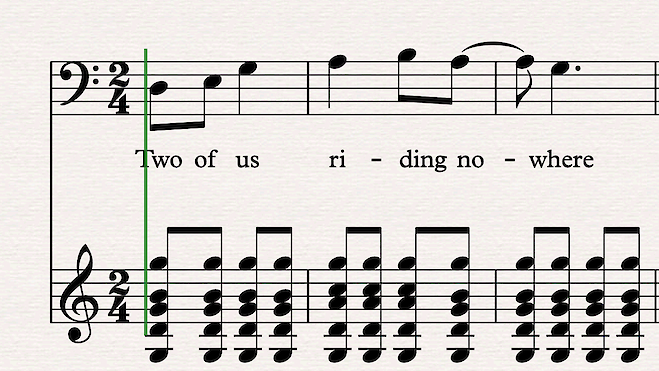
Chords G; G with 9th & 4th; G again
Or, if you like –
G; D7/G (no 3rd); G again
Either way we look at it they’re neigboring tones.
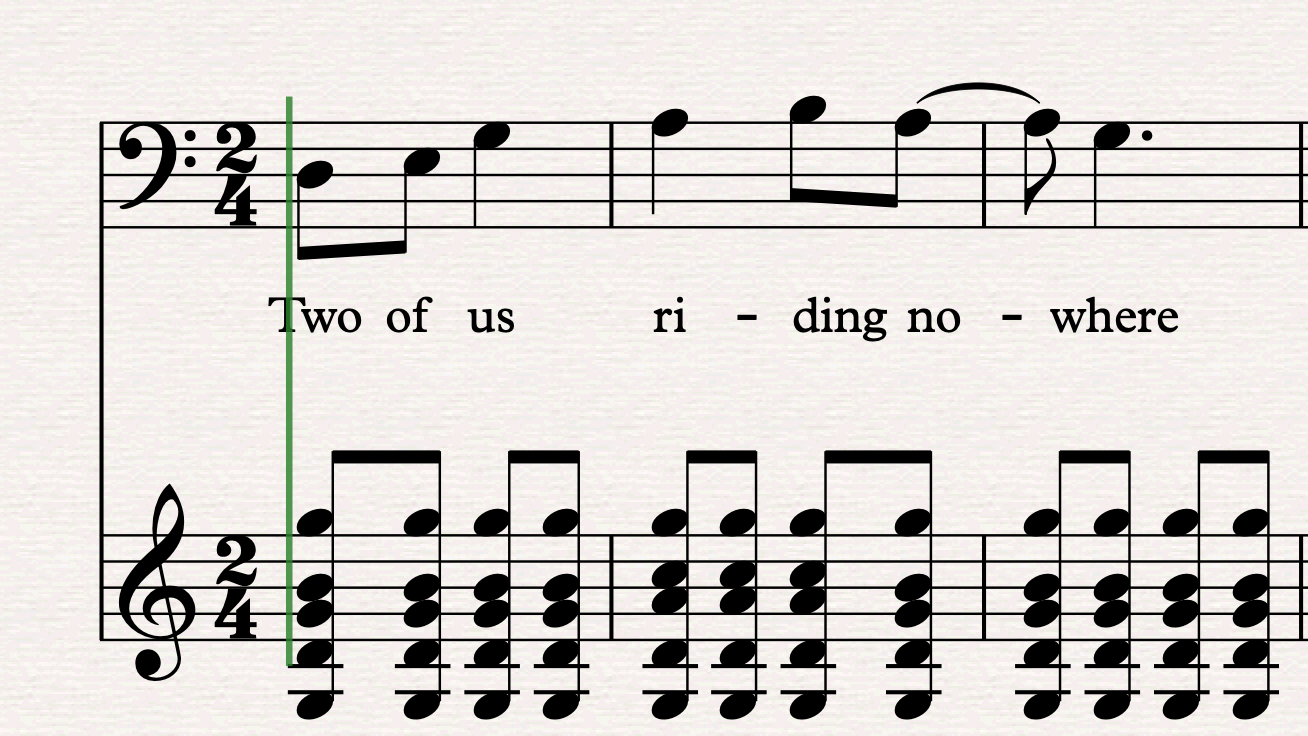
The E on “of” is non harmonic tone. I’d call it a pentatonic passing tone. If you’re committed to sticking to the pentatonic scale then the F# isn’t there.
The A on “ri-” is a neighboring tone.
The guitar supports the A in the melody.
The B on “-ding” is a chord tone, but can we also think of it as a neighboring tone to the A?
Or if you take the 2nd chord as a D7/G, then A becomes a chord tone. B is still neighboring tone.
I can’t think of this song without getting all teary becaue it goes back to 4th grade at Heath Elementary where the album Let It Be with a turntable was in a corner of the experimental open classroom in Brookline, MA. This song & I have memories longer than the road that stretches out ahead.
I love the nieghboring tone chord – G with added 4th and 9th, but I cannot separate the chord from the song or the melody. If I play that chord, I’ll think of this song.
Would I like the melody with a different harmonization? I can imagine harmonizations that would make the rising and falling pentatonic scale fall flat. I could compose many boring harmonizations of this tune. The bad harmonization might make me feel hopeless about the state of the world and the state of music, and I might begin to feel that neighboring tones are stupid, and then I might get bearish on music and life altoghether.
But I cannot rule out the possibility that someone could find a different harmonization that’s revelatory, that’s drop-dead gorgeous.
“America” by Paul Simon
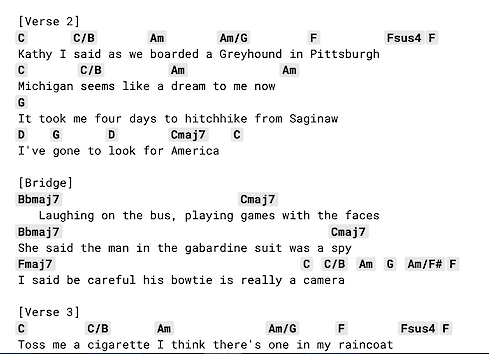
After each walkdown there’s an F chord ornamented repeatedly with a Bb neighboring tone (sus4) – C D/B Am Am/G F Fsus4 F Fsus4 F Fsus4. Some would think of that as *pointing* to the Bbmaj7 chord at “laughing on the bus”.
Fsus4 is on its way to becoming the Bb chord which only occurs once in the song. The Bb chord at “Laughing on bus” fulfills a promise. Ornaments can point, foreshadow, make promises; this is to say that an ornament can rise to a role beyond ornamentation. An ornament can point to a structural event. An ornament can be fated to be part of something great, and if it’s these terms are merely relative – *greater*.
Can the Bb chord at “laughing on the bus” claim to be heard outside the memory of the Fsus4? I say no. There’s something cumulative.
That kind of *immanance* is something that we expect from 19th C. German music like Beethoven & Brahms. Immanance is big in Kant, Husserl and Schenker.
I’m sure you’ve not heard the last from me on this.




William Anderson is a guitarist and composer and an advisor to the Roger Shapiro Fund.