
Outline for a Small Music Festival
Outline for a Small Music Festival
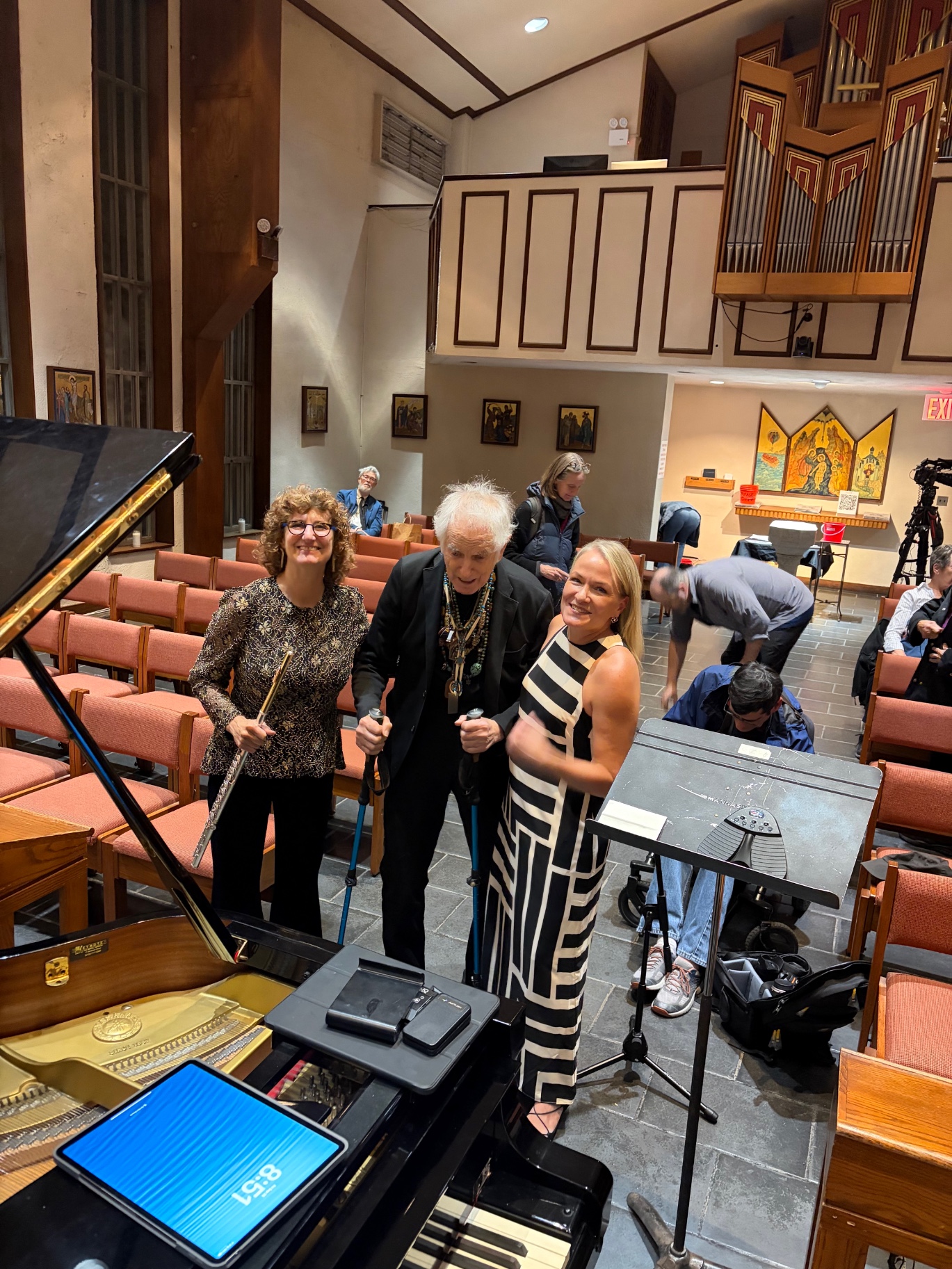
Composer David Amram, with flutist Mindy Kaufmann, left; pianist Molly Morkoski, right.
////
Cultivation of the “Small” in the Public Sphere
Before going further, it must be said that the programming ofJacob Ashworth’s organization, Cantata Profana, was very much in accord with what I’m outlining below. He would incude a Mozart minuet from a string trio on a program that featured the Schoenberg Serendade. His pioneering work was before Covid, I think, and before the US became infected with a sad echo of Napoleonic hubris.
A Small Music Festival
To dismantle the contemporary cultural reliance on institutional spectacle, monumentalism, and corporate gigantism, such a festival would have to operate as an intentional manifestation of Jean Paul Richter’s “inverted sublime.” By shifting the structural scale from the overwhelming to the minute, the public sphere can be reclaimed as a space of democratic defiance.
RSF’s collaboration with The Village Trip was somewhat in this spirit, but we need to go further in many respects. The RSF commissioned David Amram’s song, “Ah Let’s Go Back to the Village”. The song’s text and title were culled from words by his great friend Jack Kerouac.
The programming, spatial design, and operational ethos might best be anchored by the following four structural pillars:
I. Eschewing Musical Historicist Claims
Linear historicism reduces art to a museum artifact and a curated march of canonical “masterpieces”. The festival will actively disrupt this chronological hierarchy to restore music to its immediate, vibrating phenomenon.
• Anonymized and Affinity-Based Programming: Program billings will strip away composer names, centuries, and academic designations. Audiences will not be invited to historical retrospectives. Instead, works—ranging from a Renaissance lute fancy to a modernist micro-composition or a raw field recording—will be juxtaposed strictly by shared emotional Affekt, acoustic affinity, or somatic density.
• Atemporal Curation: By breaking the illusion of teleological musical “progress,” the festival highlights the continuity of human expression. Music is liberated from its historic pedigree, shifting the audience’s engagement from academic consumption to an immediate, unmediated encounter.
II. Radical Domestication of Space (The Anti-Spectacle)
Traditional festival architecture relies on physical distance, massive stages, and blinding production to enforce passive consumption. This initiative demands a severe, domestic leveling of spatial geometry.
• The Flat-Plane Acoustic Horizon: We can try to avoid the traditional elevated stage . Performers and participants will sit on the exact same physical plane in extreme proximity.
• Micro-Acoustic Focus: The festival will reject electronic amplification and massive ensemble configurations. Programming will prioritize instruments of fragile, quiet interiority—such as the Renaissance lute, the clavichord, the solo unvarnished voice, or gut-stringed violas da gamba.
• Integration with Ambient Environments: Performances will occur in spaces where the external world cannot be shut out. Following a philosophy where natural occurrences are not acoustic interruptions, the purling of water, a passing rain shower, or the wind through trees will be treated as active, organic co-performers in the space.
III. Deepmphasizing Virtuosity as Mastery
The standard spectacular concert model positions the performer as a hyper-individualized hero conquering an athletic score. The festival will intentionally de-escalate this transactional relationship.
• Democratizing the Aesthetic Experience: Realigning the event with art as an everyday, shared experience ensures that performance is removed from a framework of monumental achievement. It repositions music as an act of immediate communal necessity.
IV. Celebrating the Fragmentary and the Idyll
Where historicism demands massive, monumental structures—such as multi-movement symphonic works—this festival establishes an explicit sanctuary for the miniature.
• The Aesthetics of the Miniature: Entire blocks of programming might be dedicated exclusively to fragments, bagatelles, brief preludes, and unfinished musical sketches.
• The Cosmic Weight of the Small: By focusing the curatorial lens on brief forms, the festival establishes that a five-second musical scrap can hold as much infinity as a massive symphonic work. It honors the small, local, and transient as the ultimate site of cultural renewal and resistance against grand hubris.
Appendix: The Aesthetic and Political Lineage of the “American Small”
To anchor the festival’s structural design in a native intellectual tradition, this appendix outlines how the prioritization of the minute acts as a foundational, counter-cultural value across American philosophy, literature, and political theory.
The “American Small” is not a passive retreat into isolationism, but a lineage of democratic defiance that rejects European monumentalism, rigid rationalism, and historical gigantism. It proceeds in the spirit of Hamann, Adalbert Stifter and Jean Paul Richter until it is overwhelmed by the American penchant for spectacle.
1. Ralph Waldo Emerson: The Democratic Familiar
In “The American Scholar” (1837), Emerson codified the Transcendentalist pivot toward the micro-sublime. He explicitly rejected the European romantic demand for the remote and the colossal.
- The Horizon of the Low: Emerson famously wrote, “I ask not for the great, the remote, the romantic… I embrace the common, I explore and sit at the feet of the familiar, the low.”
- The Conceptual Weight: For Emerson, the universal laws of the cosmos do not require a cathedral or a symphonic monolith to manifest; they are fully encapsulated within “the meal in the firkin; the milk in the pan.” The small is a complete, self-contained portal to the infinite.
(Emerson, “The American Scholar,” Phi Beta Kappa oration, Cambridge, August 31, 1837.)
2. Walt Whitman: The Equalized Blade of Grass
Whitman transformed Transcendentalist theory into a radical, populist poetic form. His grass lines share the structure of Jean Paul’s “inverted sublime,” in which a small thing is held against the cosmic and made equal to it.
- The Ultimate Miniature: In Leaves of Grass (1855), Whitman treats a single leaf of grass as an object of profound, cosmic dignity, asserting it is “no less than the journey-work of the stars.”
- Anti-Hierarchical Scale: By shrinking the aesthetic distance between a cosmic deity and a common laborer to zero, Whitman weaponized the miniature to level social hierarchies. The micro-particular is the ultimate engine of democratic equality.
(Whitman, “Song of Myself,” section 31, Leaves of Grass, 1855.)
3. William James and John Dewey: Pragmatism and Somatic Immediacy
The American Pragmatists rescued aesthetics from Immanuel Kant’s abstract, sky-high criteria, grounding the experience of meaning directly in everyday, local, and immediate life.
- William James: James rejected the “block universe,” the rigid, totalizing systems of absolute idealism, in favor of a pluralistic, loose, and granular reality where small, individual choices carry real existential weight.
- John Dewey: In Art as Experience (1934), Dewey argued that true aesthetic fulfillment is found not in remote high-art institutions, but in ordinary, active human occupations. Meaning lives in the micro-rhythms of everyday existence: a child playing, a mechanic working, or a community collaborating.
(James, A Pluralistic Universe, 1909; Dewey, Art as Experience, 1934.)
4. Abraham Lincoln: The Pragmatic Small
Lincoln’s political pragmatism rests on the same conviction: large results are already contained in small things, and the work lies in attending to them.
- The Overlooked Familiar: In the Lecture on Discoveries and Inventions, Lincoln says that “ever since water has been boiled in covered vessels, men have seen the lids of the vessels” rise and fall, and that “after many thousand years, some man observes this long-known effect of hot water lifting a pot-lid.” The thinker then reasons that “the force that lifts the pot-lid, will lift any thing else, which is no heavier.” The 1859 version describes the lids rising and falling “a little, with a sort of fluttering motion, by force of the steam.” Steam power comes from taking a kitchen detail seriously.
- The Blade of Grass: Addressing the Wisconsin State Agricultural Society, Lincoln says that “Every blade of grass is a study; and to produce two, where there was but one, is both a profit and a pleasure.” The smallest thing in the field is worth sustained attention, and its yield is measured in the plainest terms.
(Lincoln, Lecture on Discoveries and Inventions, 1858–1859, with the “fluttering motion” wording from the version dated February 11, 1859; Lincoln, Address before the Wisconsin State Agricultural Society, Milwaukee, September 30, 1859.)
I’ve seen better proto-pragmatist quotes from Linclon; I’m still searching.
Richter’s comic inverstion of Kant/Schiller’s sublime reaches the US via The Katzenjammer Kids, the American manifestation of Busch’s Max und Moritz, and it sets the tone for the Marx Brothers and the Warner Brothers cartoons, and much else.




William Anderson is a guitarist and composer and an advisor to the Roger Shapiro Fund.