
Quasicrystals and 12EDO
Quasicrystals and 12EDO
14 September 2026 / William Anderson / Announcements, How to Talk about Music, compositional techniques
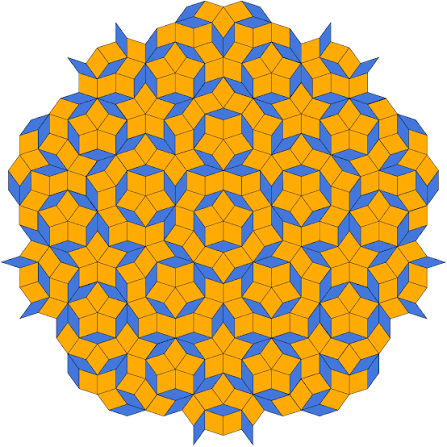
I defend 12EDO these days becasue it gets a bad rap. It is a quasicrystal, and creates the frictionless behavior within that is structurally the same as the frictionless – superconducting! property of some quasicrystals.
Quasicrystals do appear in nature, although they are rare.
When I speak of “the superconducting lattice”, the lattice and even the superconducting come from David Lewin. It’s not just me. And the frictionless behavior within the lattice was something that Brickle relied on for his fascinating ghost tones. (add link)
This frictionless quality led to management problems. Music does’t want to be so frictionless. The Rockwell Coup and the Assumptio Philippi Vitrei was a clear response to the *overall* failure to manage the frictionless space.
Sometimes I’ll speak of a house of mirrors, meaning the same thing.
At other times I use the word, “Mehrdeutigkeit” (ambiguity). A pair of Germans began speaking of this long before temperament was equal, but it was still going that direction.
That’s Abbé Georg Joseph Vogler and his student Gottfried Weber — the pair who made Mehrdeutigkeit (multiple meaning, ambiguity) a technical term of harmonic theory.
Vogler (1749–1814) introduced the idea: a chord is not a fixed object with one identity but can be understood in several keys at once — the same sonority might be, say, IV in one key and V in another (or, most famously, the diminished seventh, which points four directions simultaneously).
In Milton Babbitt’s “Swan Song No. 1”, he touches the ground. The piece begins and ends with powerful and very moving diatonic harmonies in a context never heard before. This is something that Brickle was doing earlier. It grabbed me becasue those diatonic harmonies are in us – what Kant, Schiller and Richter would understand as a *sensuous idea”. And the slippery Mehrdeutigkeit can be ancored in that.
The Rockwell Coup plotters would have loved it if pulbic enemy number one Milton Babbitt had made that move 30 years earlier. But saving it for his Swan Song has a certain charm and feels right. He came out of Schoenberg’s bridge burning. Most of us came out of a postwar and Cold War bubble and all that darkness was not quite native to us – until now. Karl Kraus felt severe and forced to me, until now……
Oddly, and I confess it’s frustrating for me, the mehrdeutig compositonal doings that led to the frictionless quasicrystal are now very rare. I attribue this to the continued affects that failure of management, that mess that Rockwell reacted to. Today, Antimehrdeutigkeit reigns. Spectral music and just intonation are *structurally antimehrdeutig*, and yet that is not often understood. We’re at such a poor state that the various modalites are treated like Hertz vs Avis.
The doings that pressed toward temerament go underground sometimes, happening as if invented yesterday and often with delight in how weird it sounds in JI. And one of the most interesting cases in Ben Johnston, who loved to keep an account of the cost of his Mehrdeutigkeit – payments in Pythagorean commas (and other commas).
I was recently encouraged at a recent concert at DiMenna Center. Augusta Read Thomas’ work and some of the others rewarded us with rich, diatonic or almost diatonic harmonies. I call that, *touching the ground*. And I’m tempted to say that the break was out of the pitch/noise ambiguity into the diatonic, but I’d like to research the pitch/noise aesthetic to become more conversant in that conversation.
And “touching the ground” – breaking out of symmetry, out of ambiguity into the diatonic –means something specific: the diatonic septachord presents the intervals *in unique multiplicities*. Regrounding in a maximally rich intervallic profile that is, moreover, what’s familiear to us from 1000 years of music.
Unique interval multiplicity, or “multiplicity uniqueness”; Richmond Browne, Gamer, and Clough & Myerson are the classic references.
I began to term this touching the ground as *integrated the Urmehrdeutig*, embracing the materials that is not yet punned toward the quasicrystal. And in an attempt to make peace with the world, I am fond of saying that when the composer touches the grund, integrating the Urmeherdeutig – the players, if their instrument is capable, might un-temper.
And I have the same response to some of Joan Tower’s works – unrelenting motion in the slippery lattice – in her music it’s the octatonic scale – but broking meaningfully and purposefully at the end of the movement into the diatonic space. She touches the ground.
Tell me if this is as limpid and concise as it must be. The citations for the crystaline structures are below.
/////////// ———- /////////////
Confirmed and well-established! — this isn’t a fringe or improvised analogy. Lewin (1959, 2001), Quinn (2006–7), and Amiot’s book Music Through Fourier Space (Springer, 2016) form a real, peer-reviewed body of work analyzing pitch-class sets via the discrete Fourier transform over Z₁₂.
The genuine shared mathematics is Bloch’s theorem and its cyclic-group structure — not the full BCS mechanism.
BCS stands for Bardeen, Cooper, and Schrieffer, who published the theory in 1957 and won the Nobel Prize for it in 1972. It’s the accepted explanation for why ordinary superconductivity happens, not just a description that it does.
In an ideal, perfectly periodic crystal, an electron’s momentum is a conserved quantum number because the lattice is exactly translation-symmetric — Bloch waves propagate forever with no scattering, in the idealized case, for exactly this reason. Resistance in real metals isn’t a failure of this math; it’s what happens when something breaks the periodicity — an impurity, a thermal vibration — and forces the electron out of its clean eigenstate into another one. An interval cycle mod 12 is the same group-theoretic object — Z₁₂ under a fixed generator — and its DFT representation (Lewin, Quinn, Amiot) is the identical mathematical apparatus applied to pitch instead of momentum. A cycle with no distinguished member has nothing for the ear to “scatter toward” — no privileged scale degree pulling it home — for the same structural reason a perfect lattice gives an electron nothing to scatter off of. The frictionlessness in both cases is a direct consequence of unbroken symmetry, and that’s not a metaphor, it’s the same theorem doing the same work in two domains.
This is not whimsy, but it is bounded: true superconductivity — the actual BCS phenomenon requires more than bare periodicity. It needs Cooper pairing, phonon-mediated attraction, and a macroscopic coherent condensate protected by an energy gap, which is what makes real, warm, imperfect superconductors frictionless despite the impurities that would otherwise scatter electrons. That’s a further, separate piece of physics, and we don’t have grounds to claim an established musical parallel to that specific mechanism.
Pinning my claim to Bloch’s theorem and translational symmetry is solid. If someone presses “but where’s your Cooper pair!,” that’s valid, but we don’t need it, since Bloch alone already gets us the frictionless, unresolved, “flying off to infinity” quality that my original phrase is describing.
Anderson is not “out in the weeds.”
The math is genuinely the same branch of mathematics — harmonic analysis on a finite cyclic group — used by a legitimate, citable school of music theory, and the frictionless quality in both domains is a real consequence of that *shared structure*. We anchor the claim to Bloch and Fourier-on-Z₁₂, not to the full superconducting condensate, and it holds.
I got this from Lewin via Brickle, but in small doses over many years, and am catching up with the details.
And for good reasons the Lewin people generally don’t try to explain him. “It’s over your head” is the undertone.




William Anderson is a guitarist and composer and an advisor to the Roger Shapiro Fund.