
We Smoked the Last One an Hour Ago #4 -- TE Hulme and Frank Brickle

We Smoked the Last One an Hour Ago #4 -- TE Hulme and Frank Brickle
This is mostly aimed at topical connections to some questions the arise from TE Hulme’s essay, “A Tory Philosophy” –
–can humans change?
–whither *the identity of man*?
These became right wing pieties to push back against a cartoon notion of socialism?
I assert in response that, as far as it goes, “the identity of man” can support a left wing agenda as well as a right wing one. “The identity of man” is a theme that runs through Albert Salomon’s collected writings. Albert Salomon was a brilliant sociologist who was saved from the Nazis through his invitation to join the University in Exile. He dated Hannah Arendt and helped put Walter Benjamin on the map. “The identity of man” is a not-even-wrong perspective, or Weltanschaung. Here, I am adopting Hulme’s tactic; he declares that a philosophy should most often be reclassed as Weltanschaung.
My take; when a child acts up there’s nothing grasping, romantic, or overly idealistic in the act of reining it in.
When a big money interests take over and implalnt a tyrant in government to stack the cards in their favor, and screw the middle class, there’s nothing romantic about pushing back against that.
I am a pluralist in my taking “the identity of man” in two ways. I love it as a subtext of Imagist poetry. And I have become invested in my usurpation of it as a left wing trope: the babies need discipline. Hulme harps on disciplie.
All this got on my radar through my endless conversations with Frank Brickle. When Brickle threatened to set “The Complete Poetical Works of TE Hulme” I told him if he doesn’t, I will. We often worked that way. I asked him to set Möricke’s “Denk Es O Seele”, because I was too busy at the time. Such were our *musings*.
More musings, tangentially related: When Frank & I were first discussing the wonderful criminality and perversity of Djuna Barnes we thought of Franks’s ex, Eve Beglarian. We said, if you don’t set it, we will. And a few months later Zadee Parkinson commissioned my Djuna Barnes songs.
Even less relevant: I gave David Del Tredici a copy of Thomas Beckford’s *Vatek*, thinking he’d like it. I was bitterly disappointed to learn that he found it too tame.
Brickle & I were collaborators since the mid 80s. Our conversations went everywhere and anywhere. I admired his post-maximalism (value techniques for what they can do, without being beholden to the surfaces that we associate with those techniques). With the help of a grant from the NEA, I produced a CD of his music – Ab Nou Cor (Click Here) and Brickle’s best piece “Farai un vers” (Click Here), and his most charming and accessible piece “The Creation, A Towneley Mystery Play.
He always added something real to a subject or he helped find a meaningful path forward in whatever question came up. And he never failed to disagree with me when he felt I was wrong; I will mention a case, below.
We left the subject of TE Hulme with my observation: His Tory position is a perspective so very similar to the gentlemen poets of China. Imagism is perfectly in harmony with a Tory anti-humanist. He agreed with that. This is obvious after reading Hulme’s essay, “A Tory Philosophy”.
We left the subject of Hulme as bred-in-the-bone humanists. I can’t speak for Frank. He died shortly therafter. It is in my nature to test my resolve; I keep going back to TE Hulme’s Tory themes becasue, motivated in part by the fact that I don’t understand them. That they are alien to me suggests that my shadow is there, and so I must poke my nose there.
A year or so earlier, when talking about the anti-romanticism of Ortega y Gassett, Frank corrected me. I was modelling my understanding of anti-romanticism on Satie, thinking of it as merely to do with temperature – cool jazz (Milhaud/Brubeck) or the Gymnopedie. Brickle said I was wrong, it’s more than that. He was right. After he died I found much insight into the nuances of the subject by reading Barzun and Isiah Berlin.
I let that simmer. He did not go into details, but I now have a much better understanding of Hulme’s anti-romanticism, and I am probably now equiped to go back and read Orgeta y Gasset and Santayana, keeping in mind that Hulme’s anti-romanticism feels decidedly at odds with Orgeta y Gasset’s “ratio-vitalism” and phenomenology, and certainly even more at odds with Santayana’s “humanistic naturalism”.
And the quotes indicate claims (categories or characterizations) whose provenence and rationale need to be cited and scrutinized.
Since Frank died, the subject has kept gnawing at me. I need to get my head around Hulme’s anti-humanism. In part because anti-humanists are now destroying the US constitution, some with ideological rigor, and others merely through decline, decay and corruption. Catastrophe figures in this story. More on that shortly.
Hulme avers that there is much that is strong and appealing about humanism, but that in the end it is a trap becasue it develops inevitably and surely into romanticism. He feels western culture after the Renaissance is monolithic, all tainted by the errors of humanism. In that I recognize the attitude of Thomas Mann in his *Reflections of an Unpolitical Man”, and in the brilliantly drawn fictional character Naphta in Magic Mountain. Naphta is an anti-enlightenment figure like Joseph de Maistre. Most Americans feel Naphta is the bad guy and his fictioanal humanist counterpart Settembrini is the hero. I should not have been surprised that there were others in my life who could see it otherwise. In Gdansk, composer Andrzej Dziadek (Click) (and more Dziadek (Click) asked me who I think Mann favored of his two remarkably drawn characters. He thought Mann sympathized with Naphta. After reading Mann’s *Reflections of an Unpolitical Man* I began to understand just how much Mann was torn between the two. Wasn’t Mann working his way through his visceral reactions against his bete noires Romain Rolland and his brother Heinrich? And when Hulme says we are mostly, in the West, knee-jerk humanists, my affinity for Settembrini in my first youthful reading of *Zauberberg* supports Hulme’s position.
Hulme never capitalized “romanticism” and “humanism”.
I likely disagree with Hulme in the end, but first I must stake out some questions and seek out some better authorities where my instincts feel inadequate to the task of forming a strong opposing position.
Hulme talks of absolute and objective spheres surrounding the subjective, human, vital position. Objective reality and geometry on one side and an objective aspect of the religious perspective on the other side. This immediately sets me off. Is Hulme merely a Joseph DeMaistre or worse, a William Barr? Are we up against religious absolutism?
I would not continue if I did not suspect he is onto something that I should contend with, if not agree with.
Hulme dislikes the notion of the perfectability of man. Humans are what they are and cannot change. Any hope for perfection or perfectability is idle romanticism, based on a foundation of humanist errors. This is Hobbsian pessimism. Only discipline and certain firmly established traditions allow humans be more than a waste of space. Traditionalism is something of interest to Bannon, who reportedly reads Julius Evola. Traditionalists like René Guénon and Julius Evola are published by Inner Traditions and Shambala, where such as the Hyperboreans are taken very seriously. Hulme often cites his reading of Buddist principles to back up his idiosyncratic traditionlism.
I spent some years with a hobby of looking for respectable figures who support the notion of “the identity of man”. “The identity of man” appears many times in Albert Salomon’s collected writings. I underlined every instance. Certainly, Burckhardt spoke of this and likley Max Weber, Montesqieu, Thucydides. Burckhardt is important for this moment becasue he was a student of tyranny and we are now living under tyrants.
From Albert Salomon’s collected works:Page 55
The basic and lasting purpose of Burckhardt’s work is to reinvestigate the positive and concrtete actuality of man apart from all pseudometaphysical a prioris. It results from his fundamental experience of the dynamic course of political and social movements that will eventually end in a terrile catastrophe. For this reason, all his books–except those devoted to art–are confessions of this experience. He himself explicitly stated that his main interest lay in epochs of fundamental transformation and crisis. These convey the power and strength of human personality at its highest and lowest. Simultaneously, they show the continuity of the spirit through all revolutions and crises. His *Civilization of the Renaissance in Italy* analyzes the disintegration of the mediaeval civilization and the rise of the Christian Roman Middle Ages. *The History of Greek Civilization* is mainly concerned with the forces that destroyed the flowering of the finest civilization created by free and completely human citizens in Athens.…Thucydides writes the story of a political decay, not of the transition between different civilizations. Burckhardt is deeply struck by these first strides toward a compariative sociological method and by the insistence of the Greek author on the identity of human nature in the changing kaleidoscope of the hisotrical world. This is the reason that Burckhardt insists on proclaiming Thucydides as the ancestor of his method in spite of his being a political historian.
Thucydides is more than the ancestor of Burckhardt’s method. He has established the true image of scholarship in times of emergency. He does not comfort the Athenians; he serves no interest except the search for historical truth. His book was composed not for the applause of his contemporaries, but as a “possession for all time.” It will not serve the narrow pragmatism of practical and utilitarian men who read history to learn how to behave in order to be successful. Thucydides strives for what Burchkardt has called the “higher pragmatism.” He enlightened his contemporaries and later future generations so that they will remember this situration in analogous cases and will be able to make them transparent by the careful reference to the human constitution and its requirements.TS Eliot:
“For the question of questions, which no political philosophy can escape, and by the right answer to which all political thinking must in the end be judged, is simply this: What is Man? what are his limitations? what is his misery and what his greatness? and what, finally, his destiny?”
Hulme insisted that man doesn’t change, is not perfectible. And the bits in bold, above, helped convince me that Hulme is partaking of and expounding an established strain of pessimism. It’s broadly Hobbesian. Wasn’t that pessimistic position shared by Pound and Eliot, Yates, and maybe Lorca? Americans live in a Velvet Underground bubble and so we find all these old Tory values surprising and upsetting.
Next, Hulme contends there is an objective, absolute aspect of the pre-humanistic Religious mindset. This triggers a humanist. It reeks of blood and soil. It reeks of Naphta. And yet he may be talking about something that I can relate to. Hulme leans hard on original sin. Hating the notion of original sin is a humanists favorite pasttime –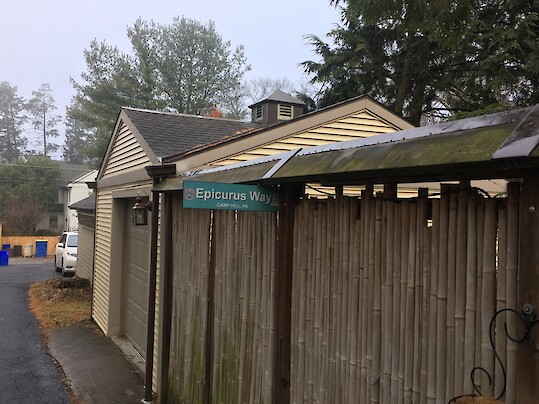
Epicurus Way, was my father’s alley in Camp Hill. He was taking a stab at a dear friend a few blocks
away who named his alley, “St. John’s Alley”.
Proud atheists like Christopher Hitchen and Richard Dawkins love to hate original sin. They don’t understand it. My father was the same. My son was a philosophy/English major who came to an understanding of original sin more like what I hold, that I absorbed through Yates and Hulme, but also Arthur Schnitzler, Jung, Freud and RD Laing.
Tangent: My father was briefly a protege of Ross Speck, of the University of Pennsylvania. Ross Speck was in the Tavistock circle, as was RD Laing and Roger Shaprio, the eponymous psychologist and husband of Dina Koston, who founded the Roger Shapiro Fund. During his brief flirtation with psychology, my father and Ross Speck hosted RD Laing at the University of Pennsylvania. My father decided to go into internal medicine becasue he felt those shrinks were all certifiable lunatics.
I see original sin as a sprawling mess that nevertheless is in the main undistinguishable from what RD Laing calls *the divided self*. And it should be no surprise that in a chapter heading of a book by RD Laing there is this lovely quote from Sir Thomas Brown –
“…that great and true Amphibian whose nature is disposed to live, not only like other creatures in divers elements, but in divided and distinguished worlds.”
This quote from Sir Thomas Brown opens the first chapter of RD Laing’s *The Politics of Experience*.
I must note here that the great lone wolf and maverick composer Robert Pollock set RD Laing’s “Knots”, or portions of it, in a work that must be recorded. If it had a guitar or mandolin I’d have recorded it already. Instead check out Pollock’s masterpieces, Romance-Fantasy or Entertwined.
What Hulme calls *original sin* I’d call, *the divided self* to avoid a fight with my father who is allergic, for good reasons, to anything that the church might use to manipulate or subdue, chiefly *original sin*. My father’s humanist abhorrence of *original sin* made it impossible to use the word in his presence.
My son introduced me to Ricoeur and is *hermanuetics of suspicion*. I was ripe for that. Over the years I’d become deeply suspicious of words and I’ve known all along, on some level, that such has to do with fundamental inner incompatibilities. The amphibian mentioned by Sir Thomas Brown is a kind of pluralist. Somehow, we render unto the head what is in that purview and we grant sovereignty no less to what’s in our gut.
A host of readings in pluralism are now called upon. The most important for me was *A Stroll with William James* by Jacques Barzun. And also very important are books by Isiah Berlin such as *The Roots of Romanticism* and “The Twisted Timber of Humanity*.
Many bits might be quoted here from Barzun & Berlin.
Tangent: Pianist Lynn Raley heard from Wuorinen himself that Barzun wrote the young Wuorinen a letter of recommendations. The composer’s father would have been a colleague of Barzun.
I do not discount the notion that the objective fact that Hulme honors in his pre-humanist “religious attitude” is a very particular notion of original sin that feels how, to the brain, the body is a monster and to the body, the brain is a monster. We see this mutual horror playing out in our imaginations, in horror movies and fiction.
There is likley more to Hulme’s conviction of absolutes in the religious attitude, but it is original sin that he harps on endlessly.
Jungians consider archetypes objective facts. Could Hulme have been onto that? Imagism performs archetypes as objective facts, and so while Hulme doesn’t talk of this much, I am considering the strong possibility that Hulme, like Yates and Goethe, got this objective aspect of the archetypes – forces and figures hard wired in us.
I’ve established quite a bit here. Are we anywhere near being able to stake a position? Hulme hated philosophy as much as William James and Frank Brickle, and his approach to epistemology stikes me as remarkably in harmony with adversaries like Bertrand Russell, with whom Hulme sparred. I feel Hulme would have liked DH Lawrence’s notion of “The Quick”. Isn’t it “the quick” that speaks to us in Hulme’s and others’ imagistic poetry?
James did not reject philosophy. He wanted it to be strong and know its limitations. We find something similar in Hulme’s attitude. He is fine with philosophy when it is renamed, “Weltanschaung”. He owns his Weltanschaung and spells it out.
Can we stake out a Weltanschaung at this point?
–We’re with the divided self and we see how that connects to original sin as Hulme understands it? the sprawling?
–We appreciate the objective aspect of the archetypes?
Do we agree with the unperfectibility of humans? How far do we go in embracing *the identity of man*?
I was at first offended by Hulme’s Tory philosophy. We got rid of slavery. The arc of history tilted.
But as soon as we got rid of slavery we entered into an evil pact with the southern racists, and that is biting us now.
And we are seeing now how oligarchs can buy out our public servants and turn them against us.
The pessimism could be defensible in this whack-a-mole aspect of evil and exploitation. Jean Gebser shares with Burckhardt a concern and appreciation for *ever present origins*. Gebser’s book, as translated into English, is entitled, *Ever Present Origin*. We are ever springing up from the mire. We have ever present origins *beyond good and evil*.
Djuna Barnes taught us to love this quote from Synge – “There is no strong timber that has not roots amidst the clay and worms.” [Can’t find the exact quote. Looking.]
I can approach Hulme’s position, but I will not sit pretty and leave everything to the Tories. There are no Tories like him today.
I’m fighting becasue I’m convinced that our lives depend on it. I don’t mind being branded a romantic by the ghost of TE Hulme. I am inspired to continue Hulme’s critique of humanism out a respect for humanists like my father.
I have many remedial questions holding me back from any sense of progress in this subject. Here’s one: how are the objective, absolute aspects of the religious perspecive at odds with humanism? Unlike my father, the stubborn positivist/humanist, the divided self (aka original sin) was for me the gift that keeps on giving. It is the font of all interesting hooks and subtexts. It is our milieu.
And for me it relates musically to complementation.
Letting it simmer here for the moment.

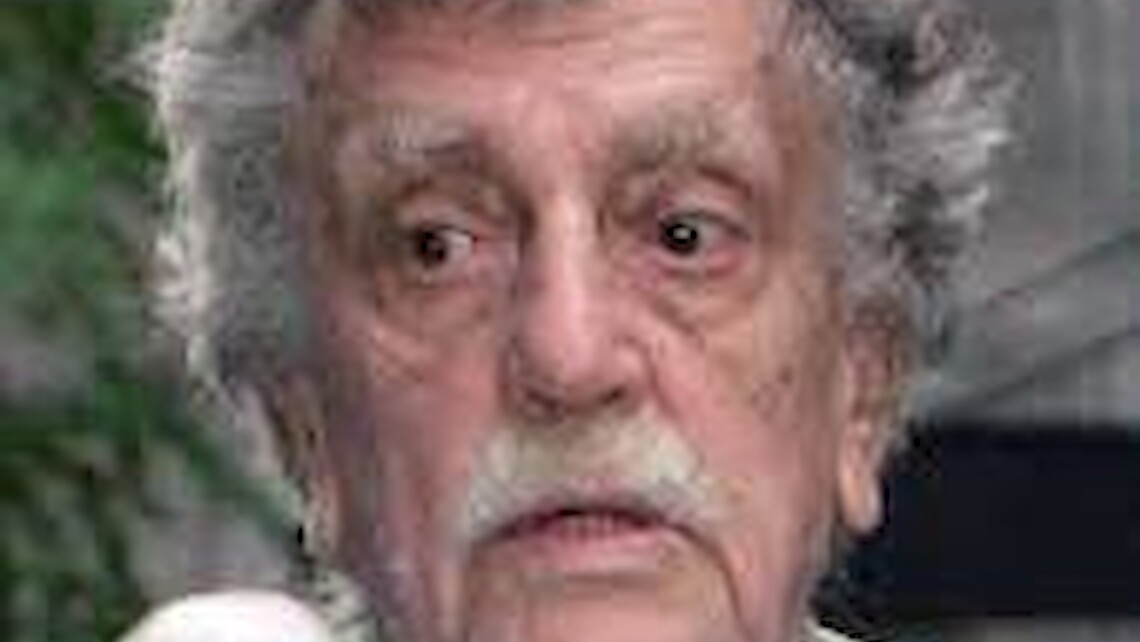




William Anderson is a guitarist and composer and an advisor to the Roger Shapiro Fund.