
The Death of Tragedy
The Death of Tragedy
The Death of Tragedy
My readings of Stifter and Jean Paul, my hearings of Brahms and Schumann, these clashed last night with Schiller’s essays on tragedy, the sublime, and the pathetic. The death of tragedy fell quickly out of that discomfort.
Schiller’s tragic hero earns the name by resistance. Pathos alone — however intense, however real — he calls common, vulgar, beneath art’s notice. A person crushed by something too large to resist, with no reserve of will left to display, has in his own words fallen out of “suffering human being” into “tormented animal.”
Dignity, on this account, is not a condition of having a body and a fate. It is a performance staged against them, and it is priced: no visible victory of the will, no standing to be taken seriously as tragic at all. Nietzsche took the structure and kept only the will.
The direction of the willing stopped mattering (will toward good or toward evil?); the magnitude of it became the whole of the value. A villain who risks everything for his vice interests us more than a virtuous man whose virtue costs him nothing — Schiller says this himself, a page before Nietzsche is born. The line from On the Pathetic to Beyond Good and Evil is not an appropriation. It is an inheritance collected early.
That structure is now visibly splitting into two positions, neither of which is quite Schiller’s, and both of which deserve to be seen as responses to the same inherited demand rather than as opposites with nothing in common.
The first keeps the willing and turns it on embodiment itself. If the mind proves its freedom by resisting what nature hands it, and the body is the largest thing nature hands anyone, then the fullest exercise of that freedom is resistance to having a body at all — its shape, its category, its givenness. This is the Schillerian gesture at maximum scope, not a rejection of his aesthetic but its most literal extension: aesthetic interest tracks the magnitude of the refusal, and refusing embodiment itself is about as large a refusal as a will can stage.
The second position, harder to name because Schiller’s own vocabulary has almost nothing for it, treats having a body as tragic and stages no victory over it at all. No pain is required, and — this is the part his system cannot process — no resistance is required either. The response is not conquest but maintenance: attending to the quotidian needs of a body one did not choose and does not overcome, tending it the way Adalbert Stifter’s gentle law tends a household, a dike, an orchard. Measured by Schiller’s own criteria this is “common” by definition — no triumph of will, nothing sublime, nothing his aesthetic was built to honor. And yet it is not resignation either. It is a dignity that does not need a victory to be dignity: tragic without conquest, tragic without a debt owed, tragic without denial. Fate accepted at arm’s length, neither flinched from nor dissolved into — amor fati turned toward the body instead of toward a life’s larger accidents.
What has moved is the center of gravity in a constellation Schiller assumed was fixed. He placed the sensuous and the rational at the two poles and let the drama of art consist entirely in watching one master the other. Both of the positions visible now have quietly demoted that drama. The first keeps the mastering but redirects it at the sensuous wholesale, rather than at a particular pain nature happens to inflict. The second gives up on mastering as the measure of worth altogether, and finds its center of gravity in a sustained, unglamorous attention that Schiller’s aesthetics has no name for because his aesthetics was never built to notice it. Tending is not resisting. It does not stage a victory, and it is not asking to be admired for one.
This is why the title is not a description of loss but a diagnosis of a structure quietly giving way. Tragedy, in Schiller’s sense — pathos redeemed only by a visible triumph of will, dignity conditional on the size of one’s resistance — depends on a hierarchy in which suffering counts for nothing until reason has been seen to master it. Where a body’s ordinary demands (or a community’s) are met with patient, undramatic attention rather than with conquest or refusal, that hierarchy has nothing left to rank. Not because suffering has stopped, and not because will has disappeared, but because the currency the whole system was priced in — magnitude of resistance, visible and measured — is no longer the thing being spent. Nietzsche radicalized Schiller’s tragic economy until only the will remained. What is happening now is not a further radicalization. It is a different economy, in which the will is no longer what is being kept score of at all.
The mechanism underneath both positions is a single reversal. Schiller’s sublime requires a maintained distance: the great and the small held apart long enough to be compared, resistance visible only as a gap that does not close. The second position — Brahms’s op. 15 grand first theme pouring into a small (bürgerlich) second theme, Stifter’s ice storm pouring into a doctor’s daily rounds — requires the opposite: the gap closing, the great emptied entire into the small rather than opposed to it. Not defeat purchasing elevation, but transfer. Where Schiller prices dignity in a distance that holds, this economy prices it in a distance that closes without either term being lost.
\\\\\\
–This is a shift in consciousness.
–This is a rebooting of the cult of the small.
–Apparently, and astonishgly, Stifter and Brahms felt Nietzsche’s unsustainable extremity before the fact and short circuited it.
–Within the framework of this Small, nothing looks so ridiculous as a strong man. Beethoven’s un-dedication sets this in motion.
–The secularization (Talleyrand, Josephinism in Austria, Mongelas in Bavaria) removes a check on Schiller’s classical position and lets it run amok and extinguish itself. Something like that.
–It’s hard for me to see Homer arguing Schiller’s point. The war, the ramblings into infinite horizons with the the bizarre stories all pour back into the homecoming and the stringing of the bow.
We are in the anti tragic world and the tragic does not disappear, it’s subsumed in the problematics of the body which plays out in two extremes –
–reject, the body, rebel against it. (Schiller would like to see that still in operation.)
–or tend to the body in Stifter’s frame of the quotidian small.
I started out in the first, then channelled everything into music, and then eventually found the Stifter framework and mechanism that explained my MO.
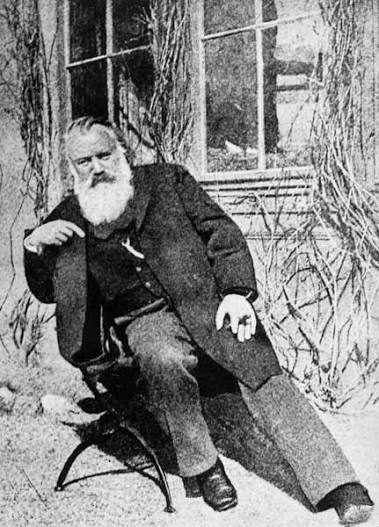
I do see Brahms as a musical Stifter, but he may not have read Stifter. He definitely read Jean Paul, but his music does not have the picaresque quality of Schumann’s, except perhaps in the Hungarian rhapsodies. Schumann also adored Jean Paul and clearly adopts Jean Paul’s devilish sense of humor.
What happened to tragedy as Schiller explains it is exactly Hermann Broch’s disintegration-of-values pathology. Once what Broch calls the *central checking system* goes (Christianity checking the classical) — each domain becomes autonomous and pursues its own logic to the absolute, with nothing outside it to say when to stop. Will-worship without the Christian counterweight isn’t a different mechanism from Sorel’s myth deriving force from being unrealizable, or from the culture-industry circle where attention creates the value that justifies the attention. It’s the same zero finding its way into the same denominator, this time in an aesthetic rather than a political or economic register: resistance-to-nature as the sole measure of dignity, with nothing left to check how far up that measure could run.
A comparably fierce resistance remains today, aimed at the body. Athletes and musicians tend to go the Stifter route and make peace with the body.





William Anderson is a guitarist and composer and an advisor to the Roger Shapiro Fund.