
We Smoked the Last One an Hour Ago BAAM Edition: Holding and Letting Go
We Smoked the Last One an Hour Ago BAAM Edition: Holding and Letting Go
30 June 2026 / William Anderson / On the Beat, Compositions, How to Talk about Music, compositional techniques
Holding and Letting Go
Chapter 1 of The Illusions of Postmodernism (1996) opens by inviting the reader to imagine a world where the Left had suffered a crippling political defeat. Eagleton’s argument is that postmodernism’s signature moves — suspicion of grand narratives, suspicion of totality, the revolutionary subject — make more sense as the intellectual residue of that defeat than as free-standing discoveries. As he puts it, radicals can come to “hug their chains, decorate their prison cells, rearrange the deck chairs on the Titanic and discover true freedom in dire necessity.” Yahoo Finance
Postmodernism, in this view, is what happens when a generation keeps the mood of revolutionary commitment while quietly giving up on the thing ever arriving — waiting for “Godot.”
This is from the opening of Chapter 1 of The Illusions of Postmodernism (1996), which originally appeared as an essay in Monthly Review. Eagleton opens by inviting the reader, using a device he borrows from postmodernist rhetoric itself, to imagine a world in which the political Left had suffered a crippling defeat. The argument that follows is that postmodern theory’s signature moves — its suspicion of grand narratives, its suspicion of totality, of the revolutionary subject, even of “system” itself as a meaningful category — make far more sense once you see them as the intellectual residue of that defeat, rather than as free-standing philosophical discoveries.
He argues that if postmodernism’s exponents had instead come of age during the birth of some inspiring new form of social life, it’s “morally certain” they would not hold many of the doctrines they do — since a flourishing mass radical movement makes it easy to see the System’s supposed “Others” as themselves products of the system, not its angelic opposite.
Eagleton observes that radicals, like everyone else, can come to “hug their chains, decorate their prison cells, rearrange the deck chairs on the Titanic and discover true freedom in dire necessity.”
The book’s whole opening gambit is that postmodernism is what happens when a generation keeps the mood and moral seriousness of a revolutionary commitment while having quietly abandoned any real expectation that the thing being waited for will ever arrive.
I can easily dispense with Terry Eagleton’s “Waiting for Godot” idea. The value of the 20th C. modernist composers are in the value of specific works *that overwhelm with specificities the ideals that they embody*. When we keep to the musical thing right in front of us and resist idealizing it, resist turning it into an ideology, we are happier and unmolested by postmodernism’s failed revolutions.
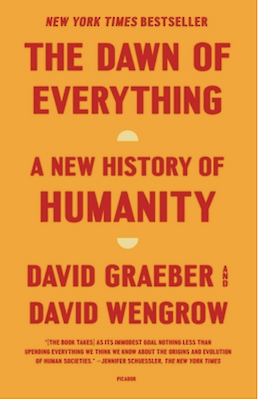
We are in an anti-historicism moment. Anti-idealist & antihistoricist writings that are out and about now:
I found them both in Berlin first, and only later find they’re getting around in the US.
I love to talk about ideals, *regardless*. Jacques Barzun & William James & Bergson will all argue powerfully for “the quick” (See DH Lawrence) – what is alive is the specific artifact; the ideals are dead. That’s a value inversion and the process of an aion of gestation – 2000 years with Platonic idealism.
We are in an anti-idealist moment and I’m happy to be there. I understand it. But William James, our favorite anti-idealist, valued philosophies and their idealisms. Bring them on, he said, *but know just how far they go*.
An ideal is a starting premise for a work, the work itself cures you of the idealism when it shows itself to have overwhelmed with specificities all its initial premises. This is Goethe’s systole and diastole.
Many times I explained to my father what was making me go and what was keeping me fascinated and engaged with art and life. Once he said something that was very memorable in response to my ebullience.
You know, *everyone* has things that resonate deeply down to the very bottom of their soul.
Ok, dad, thanks. He was urging humility, I guess.
I’m still figuring out what to make of his comment. I came to this – we all have our epiphanies; while we are in the grip of a big moment, we’ll likely shut out many other powers and capabilities. !Pokemon! or the inner discipline that was alchemy.
We all respect one another’s space, and we all try our best to read each other. And because we are musicians, we have palpable, visceral artifacts of our internal spaces. How wonderful is that? We can engage with one another without using words, but with notes.
And we fellow travelers respect the pluralistic musical universe. We know we’re all constituted very differently, we all feel things deeply and we respect those deepest wellsprings in each other. We even allow for the possibility that we can learn to love what others love.
We are not islands. Maybe this also comes from my father’s admonition: I have come to dwell not on what I’m doing that is unique, but on how what I do relates to our shared desires.
I am counting on you all to supply important insights that I am missing.
Macherey
The Roger Shapiro Fund’s mission includes the word, “modernist”. Dina Koston asked me to run the RSF because I had fallen in with modernists and I championed modernists, including Dina Koston. When I first met with our Trustee #1, Susan Sanders, we both agreed that the mission statement, and that word, “modernism” might eventually become problematic, or meaningless.
After 15 years I have found the way out. 20th C. modernisms are a profusion of new techniques and modalities. Lasoo (draw a cricle around) the 20th C. modernisms in a grand ekphrasis and treat them like well known and much loved affects in a pantheon of such. In short, I’m leaning toward setting off a classical period in which we negotiate joyfully within these things that are no longer new, but negotiable coin of the new realm.
The Rockwell Coup
The Rockwell Coup turned a page. It was a power play. His standing with Paul Fromm and with the NY Times allowed him to decisively vanquish modernism.
Others were, perhaps Taruskin, were ready to help with the project.
–David Amram’s story
–Leon Fleisher’s storyMichael Tilson Thomas telling Andrew Imbrie to scram.
I was defensive for a while, but I had to concede that modernisms had become problematic.
Mission creep –> symmetry death and later a reactionary specificity death
We return to this subject if we have time to delve into Mehrdeutigkeit, the Urmehrdeutig, Unmehrdeutig and Antilmehrdeutig.
I gradually embraced the Rockwell Coup. But it was a sledge hammer. It needed a finer instrument. It’s so often the case that when we burn bridges we do it heavy-handedly.
I am happy to giving up “the modernist texture”. And I am happy to avow that my favorite post-tonal works were a wonderful extended tonality or polytonailty . I was feeling and digging a fresh light on diatonic harmonies.
I am not ok with giving up modalities. Many powerful musical modalities – musical doings – got stranded by the Rockwell Coup. And modalities no not have to be fixed permanently in the soundworlds of their pioneers.
I have been called a warehouseman of stranded musical assets. Valuable musical assets are sitting around waiting to be put to work again, but not in ways that sound like what everyone grew tired of.
We will learn that doings do not have to be wedded to a particular sound or style. I put the stranded assets to work in sneaky, surprising ways. I never know how I’ll do it next.
The 20th C. saw a profusion of experiments, modalities, value inversions, and they often have one celebrated exemplar.
Value inversion – Brahms & Schoenberg focused on the horizontal. The Baroque began a homophonic focus. I’m back to the homophonic.
I’m seeing a moment of integration that keeps practices alive, applying the modalities better, simpler, clearer, I don’t think we need to let anything go.
Lasso all those 20th C. things and try to make them work together in new ways. And make those things work with new 21st C. things. Align them with more recent doings. There’s strength in those alignments.
Alignments
Morton Feldman’s Wolpeisms (and Leo Brouwer’s too)
Judd Greenstein’s *breaking the pan-diatonic* is such an alignment.
Joan Tower’s *breaking the octotonic*, likewise.
Ekphrasis
Lassoing
- Song Dynasty
- Vergil
- The British Invasion
- Our 21st C. Ekphrasis of the polyglot 20th C proliferation of modalities.
“Holding” in another, purely musical sense
My interest today is in holding tune/harmonies. I’ve been talking about holding onto modalities - doings.
Holding and letting go is one of those modalities and I want to discuss some fun examples. The Judd Greenstein example is a good start.
Schubert
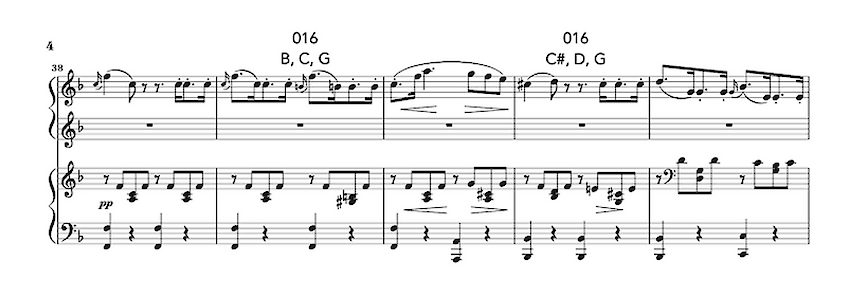
F Minor Fantasie holds 016.
https://youtu.be/S_rqngIvmLM?si=QfCj9fzIS0XscXoZ
Led Zeppelin
Houses of the Holy holds 016
No Quarter
https://youtu.be/_vG_mTt6hCs?si=MTIrq4hJPFbVG_md
Dancing Days
https://youtu.be/mbsCo7TvzRQ?si=d6_HmUnPTvqzdTXI
Berg Sonata op. 1 starts with 016
Harold Meltzer
each section holds and *extends* specific interval content.
Brion
https://youtube.com/playlist?list=PLTusF-fsM8Tfv9AyKgNvhtrs9Dsj3I_ai&si=lt0lJ-FG5U4jUglf
Doria Pamphili
Like “The Banquet”, Doria Pamphili holds 045.
https://youtu.be/dutfFQDKwRg?si=2y3QQZMy0Eb9byyy
Compare with Joni Mitchell’s The Banquet
The Banquet
https://youtu.be/qTAV9cngmmY?si=UcpTxsmiGtQpigv3
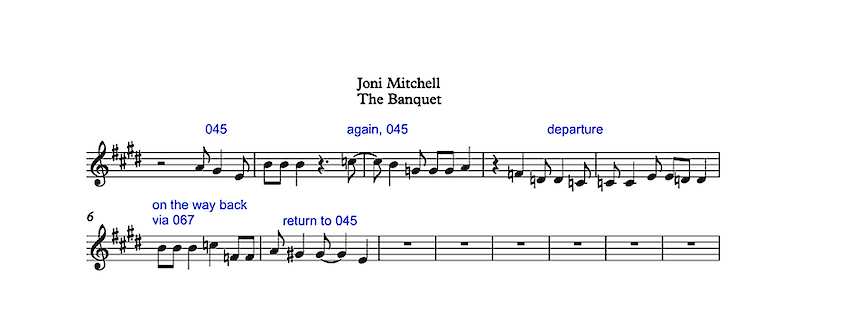
Same sound is here in the Allemande. This is perhaps the earliest case of something that is *being held* that is not just a triad:
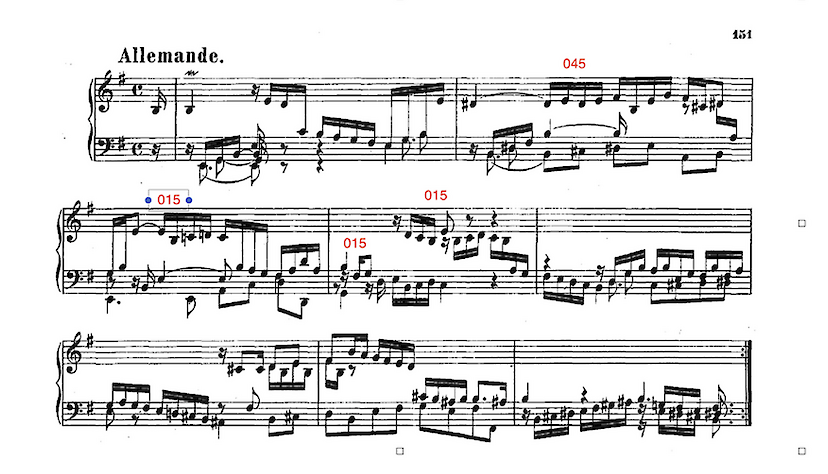
Brahms cello concert, also in e minor, is all about these sounds – E - - - G - - B C - - - B - - -
David Lang
Little Match Girl
2:48 — something extrinsic to the opening
https://youtu.be/CDSnTsdH75A?si=pn3URpyiyWaa0saE
Wed
Those harmonies that stand out create *collection boundaries*
https://youtu.be/eFWCvs7KQ40?si=n-Pf57v1MybXGdqt
We might look at some John Adams music to find movements that *hold* a quality. I remember the quasi Medeival (Notre Dame School) movement in El Niño.
Babbitt Swan Song
0127
Holding, section by section —
Meltzer Brion
Holding movement by movement —
David Lang Little Match Girl
Judd Greenstein and New Amsterdam
In their blood is pan-diatonicism, and then sometimes, a desire to break it.
Joan Tower: Octotonic for first 4/5ths, then she breaks the Octotonic and cuts to diatonic
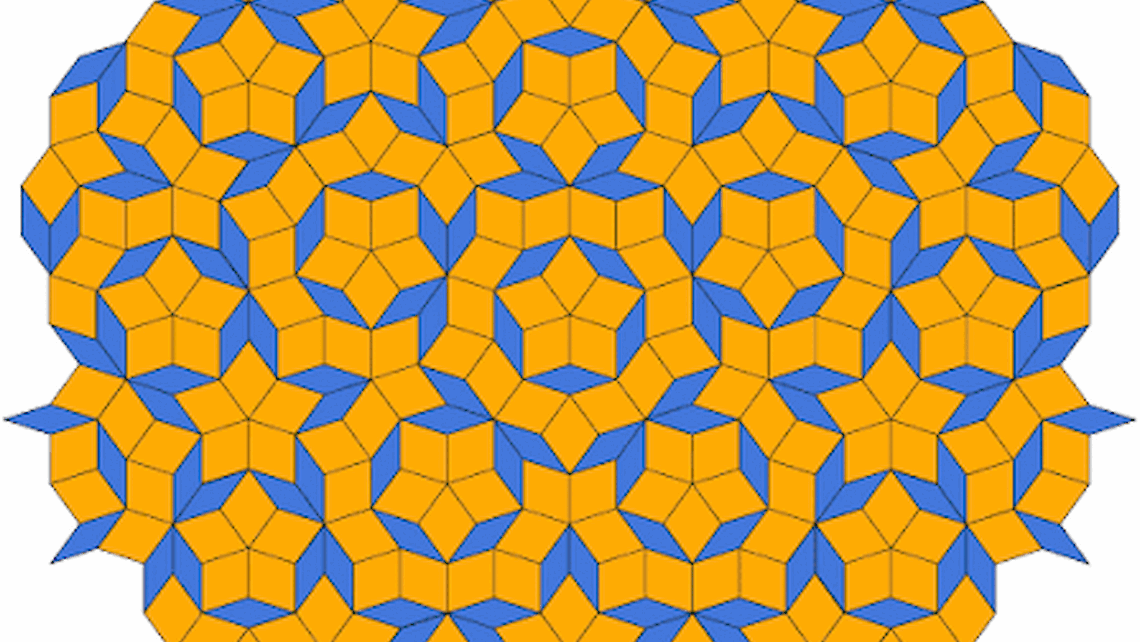
That’s called a broken symmetry.
Broken Symmetries
Wolpe taught it famously to Morton Feldman, but also to Leo Brouwer.
I think Feldman talks about it.
Brickle
broken symmetries and ghost tones
The Creation
Genius Loci
The Beatles provide the most brilliant example of a broken symmetry.
Mother Nature’s Son begins with a broken symmetry.
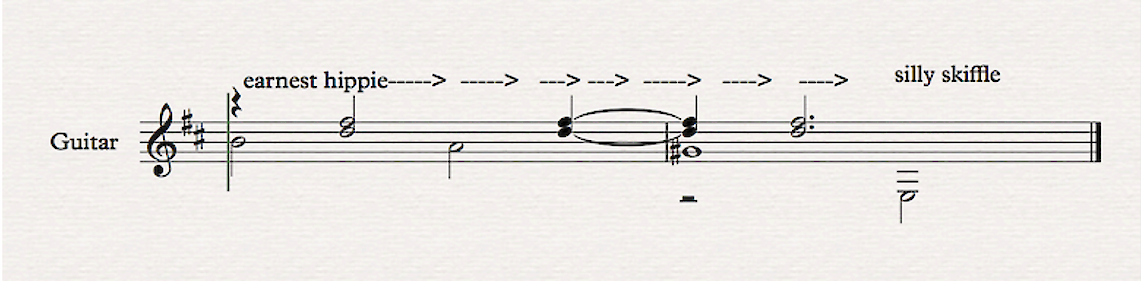
Ekphrasis
Lassoing — ekphrasis
Song Dynasty
Vergil
The British Invasion
Kentner Anderson Piano Trio
Brahms
His *keeping everything Burgherlich*
That is my hope in the first 1/2 of the piece.
Schoenberg
5\2; 1\2 partition from Op. 27 #4
Crumb
The ending (instead of Mahler, I have a cowboy song)
Carter
ATH and *aspects* of that
While Carter was moving in one direction, I move in the other direction, toward Brahms and the Bürgherlich.
Babbitt
multiply partitioned array
But my use of the word, *holding*, is also meant in a specific technical sense.
Kentner Anderson Piano Trio




William Anderson is a guitarist and composer and an advisor to the Roger Shapiro Fund.