
What Happened to the Cult of the Small?
What Happened to the Cult of the Small?
What Happened to the Cult of the Small?
or
Who Cares if You Sell Magazines?
Wm. Kentner Anderson
There remains a cult of the small in the US, and its predicament is a limpid encapsulation of the pathologies or our time, the pathologies of the spectacle.
The title of Babbitt’s 1958 essay was “The Composer as Specialist.” It was famously published under the title “Who Cares if You Listen,” which was the editor’s, and which Babbitt said had little of the letter and nothing of the spirit of the piece. A commercial magazine invented a charge of contempt for the audience, and the charge was used for fifty years against people whose actual offense was declining to compete for attention.
See my recording with tenor Niel Farrell of the Cavalier Settings includes, on the flip side, Babbitt reading his riposte to that affair, decades later.
So the reply is a question the accusers never had to answer. Who cares if you sell magazines?
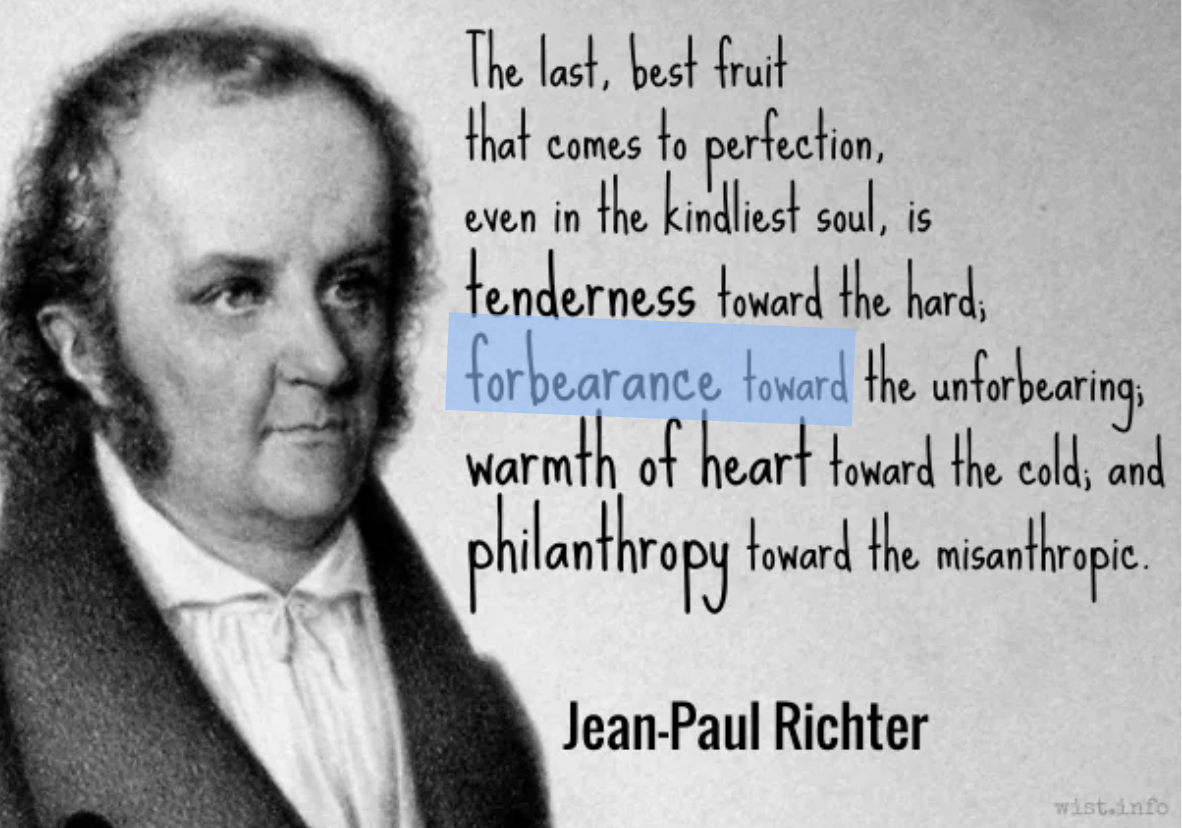
What that quarrel obscured is that uptown was a cult of the small. Brickle and I thought of ourselves as such, with an ever clearer understanding of the lineage — a lineage as long and as respectable as anything the spectacle can show. Jean Paul Richter wrote the life of a village schoolmaster who read the catalogues of books he could not afford and wrote the books himself. Schumann read Jean Paul and made “Papillons” out of “Flegeljahre.” Stifter turned the small into an ethic and called it the gentle law: the daily maintenance, the household forces, the thing that holds. Emerson asked for the meal in the firkin and the milk in the pan. Thoreau counted. Melville’s Moby-Dick sold poorly, Pierre was savaged, and he went to the custom house and wrote Billy Budd in a drawer. Whitman attended to what was in front of him. Brahms, another Richter enthusiast, tamed grandeur with classical order and Bürgerlich civility; wrote intermezzi. James located the real in individual pulses of effort, and Dewey in local publics.
These chose the small against a spectacle that was already in view.** That is the point. The emphasis was not on a failure to reach a larger audience; it was a position about where value lives.
Look at Wendell Berry: the spectacle slots him away as a niche writer, an agrarian.
The electronic music people hid at Prentis Hall. Babbitt hid there; Davidovsky was hiding there for a time. Players like me pulled them out — and we were not conscious enough of what we were doing: it was despite their being of no use to the spectacle that we pulled them out and gave their work what only the fleshy human guts can bring. When we did, the freelancers came on board, answering the gesture with real receptivity and giving the music a chance.
I came into the business during the heart of what I call the Rockwell Coup, and I have first-hand conversations from David Amram and Leon Fleisher about those doings at Tanglewood, described elsewhere. Oddly enought, I have come to the surprising conclusion that the Rockwell Coup was a necessary move.
Babbitt hid in the academy and in the electronic music studio, and came out for the Anderson–Fader duo, for Cygnus, or when Levine dragged him into public. Brickle would disappear into his own studio for months and years. He had a mantra, and I never learned where he got it (likely James): an organization forms, does its work, and disappears. That is a renunciation of the one thing the spectacle rewards, which is continuity of brand.
One of my first engagements in the eighties was for Jacques-Louis Monod’s New York Guild of Composers, to a tiny audience, model for Robert Pollock’s Composers Guild of New Jersey, which I ran for ten years. We should have gone to Jacques and asked how we could help with the public interface. Which begs a question I cannot answer: were there Melville supporters who took the author aside and asked what they could do about his public relations?
I have to be honest, because the parallel is not clean. There were notorious failures — concerts nobody came to, pieces that did not work, presentation so indifferent that an interested listener would have had to be a detective. Some of us were bad at this and some of us did not try. It is possible to hold a position about where value lives and to be, separately, not cut out for production and promotion.
But the incompetence has served as cover, and that is the part worth saying. We have been self-deprecating for decades — telling ourselves we were simply poor producers and promoters — and the self-deprecation was easier than the claim underneath it: that we were allergic to spectacle, and that the allergy was a position and not only an incapacity. Both were true at once. Sorting which was which in any particular case is beyond me, and I was in the thick of it.
Two qualifications, because the argument fails without them.
First: uptown was not powerless. Princeton, Columbia, the grants, the prizes, the departments; funding from RCA, from the State Department, and — by way of the Congress for Cultural Freedom — from the CIA. A critic will say that an institutionally embedded practice cannot claim the mantle of the small, and the answer is that these are different axes. Small in scale of address; embedded in institutions. Chamber music for forty people, funded by a university. That is not a contradiction, but it must be said aloud or it looks like one. The frame the Rockwell Coup used — a government-funded anti-nationalist program — was fair as far as it went. It described the funding and not the ambition; the people inside it had real artistic ambitions, and their work fits the framework of the cult of the small.
Second: this must not become consolation. We were not failures, we were principled is a real position and also the story every loser tells. We lost upward, in a space where losing could be avowed as a strength. The version that holds is the one where the cult of the small is a program with a lineage and results, and where the spectacle’s verdict is simply not a verdict about merit. If the work is bad, the smallness will not save it.
And there is a structural difficulty that belongs here, since it is the reason the cult is hard to sustain now rather than merely unfashionable. When the spectacle is the environment rather than a competitor, attending to the small can look like abdication rather than resistance. Jean Paul could write about Wutz because the mosaic world still existed to be written about. Stifter’s problem is the modern one — the gentle law from inside the administered society — which may be why the Americans who manage it write about places the administration has not fully reached, or about the past.
Brickle and I grappled for years with social constructionism and never sorted it, and he died before we could. What follows is where I have got to since, and I set it down because the failure to sort it cost us the argument more than once.
The uncomfortable part was never the philosophy. It was how the thing plays out in the culture industry, where it produces a circle: so-and-so is a force of nature, that is what we want, and that is what sells papers. If value is conferred by uptake, then attention creates the value that justifies the attention, and there is no position left from which to say the market got it wrong. The currency and the measure become the same quantity.
That is not constructionism’s argument. It is what happens when the argument is taken up by people who do not need it to be true, only useful — and it is worth being exact, because the constructionists I read are mostly enemies of the spectacle rather than its servants. Macherey’s materialism is an argument against the idealism a loose constructionism slides into; Eagleton, whom I admire, has spent a career on it. (Jameson I am less sure of, though my quarrel there is narrow and published: he trashes Schoenberg on weak arguments.)
My work in progress, A Book of Commonplaces, concedes half the position outright. Equal temperament is an artefact with a history. The twelve are not given. Goethe’s city is built on ground that can no longer be deciphered**. All of that is constructionism about the gamut, and I hold it.
So the line falls here. Constructionism is right about the gamut and wrong about the ear. What counts as a note is settled by history and could have been settled otherwise. Whether a passage lands is not — that is answerable to something, and the something is why this book keeps returning to performers, to scores that will not move for you, and to the ear that can be corrected. Nature is what we are answerable to; the gamut is what we agreed on.
The lineage, then, is the argument. Richter, Schumann, Stifter, Emerson, Melville, Thoreau, Whitman, Brahms, James, Dewey — and after them a scattering of composers writing chamber music for rooms that held forty people, who were told they did not care whether anyone listened. They cared a great deal. They declined to care whether it sold.
From The Book of Commonplaces, Part II.
*Jean Paul’s target is the ego that annihilates — Fichte’s absolute I, Schlegel’s irony, the self that clears the world away so it can play unimpeded. The spectacle looks like the opposite: not the self asserting itself but the self dissolved into what it consumes. So they aren’t the same thing.
But they need the same precondition, and that’s the connection. Both require that nothing be answerable to anything.Once the world has been cleared for free play in the void, attention is the only thing left to confer value — which is precisely the circle I mention aboe, where the currency and the measure become the same quantity.
Babbitt’s sense of humor, no less than Schumann’s, was Richterian. Babbitt very likely never read Richter. For reasons read his essay, “My Vienna Triangle….”. Babbitt met Kenneth Fearing, a 40s era critic of the spectacle. He met Fearing through Chomsky’s uncle who had a disability and during the depression was eligible to run a newstand, where he held court.
**This alludes to Goethe’s conversation with Zelter, wherein Goethe avers that civilization’s framing reached everywhere, even deep into the soil upon which our edifaces stand. This is social construction; the circular business is a hollow echo of this. (A paraphrase for now; see Gary W. Don, “Goethe, Boretz, and the ‘Sensuous Idea,’” Perspectives of New Music 34/1 (Winter 1996), pp. 124–39. JSTOR stable URL 833489.)
Another example is Goethe’s discussion of Rembrant’s night scene. He loves the fact that the picture clearly has two light sources. He spoke of Imagination pervading our taking of nature, as with tuning systems, for artistic purposes. Nothing against the overtone series at all.
Goethe is defending temperament, which is now under attack, often through simple misunderstandings (the Goethe comment needs much context), but sometimes with an attitude that is a perfect fit with the Romantic that Richter attacked at the head of his essay about poetic nihilists:
“From the lawless, capricious spirit of the present age, which would egotistically annihilate the world and the universe in order to clear a space merely for free play in the void, and which tears off the bandage of its wounds as a bond, that this age must speak scornfully of the imitation and study of nature.” — Jean Paul Richter
Temperament: asked and answered in 1808 by Goethe & Zelter. Note that elsewhere I seek ways to come to terms with my JI and X≠12 detractors, specifically through a call to integrate the Urmehrdeutige.






William Anderson is a guitarist and composer and an advisor to the Roger Shapiro Fund.